
2026 Shubhra Kar LiFT Scholarship Recipients
Yash Agarwal, 21, India
Open Source Newbie
Yash Agarwal started contributing to open source during his first year of college and quickly went far beyond the basics. As an LFX Mentee at CloudNativePG, he watched a Kubernetes chaos test recover a live PostgreSQL cluster in real time, a moment that turned a technical curiosity into a clear career direction. He has since merged upstream PRs in Kubeflow Trainer, authored a TrainJob CRD lifecycle proposal, and built production-grade projects running on Kubernetes, FastAPI, PostgreSQL, Prometheus, and Grafana.
Now focused on cloud-native infrastructure for stateful workloads, Yash wants to go deeper into Kubernetes operators, distributed ML training with tools like vLLM and Ray, and the chaos and consistency tooling that proves systems survive failure. He sees open source not as a portfolio exercise but as the only honest way to truly understand the systems he cares about, by reading the code and contributing back.
With support from the LiFT Scholarship, Yash will pursue his Certified Kubernetes Administrator (CKA) certification and continue building at the frontier of cloud-native infrastructure and AI.
Atharva Borade, 18, India
Open Source Tech Teen
Atharva Borade began contributing to open source in November 2025 and, in just a few months, merged 46 pull requests across projects, including Kyverno and Hyperledger's fabric-token-sdk. He found his first bug in Kyverno's leader election logic while reading the source code and submitted a fix that was accepted. Since then, he has tackled controller panics, namespace cache misses, TOCTOU races, and unbounded backoff issues, and added Prometheus and OpenTelemetry metrics across the fabric-token-sdk transaction lifecycle.
Still in his first year at Polaris School of Technology, Atharva has learned more from maintainer feedback on real codebases than from any classroom. He's now focused on the token privacy layer of fabric-token-sdk, where he wants to understand how zero-knowledge proofs are used to hide transaction amounts in production distributed ledgers.
With support from the LiFT Scholarship, Atharva will deepen his technical skills and continue contributing to CNCF and Linux Foundation projects at a level most engineers reach only years into their careers.
Agnes Nduta, 34, Kenya
Woman in Open Source
Agnes Nduta is a backend developer at Shinrai Technologies, building insurance products for one of Africa's leading insurers, a real-world microservices application in Python FastAPI, PostgreSQL, Docker, and Kubernetes. Alongside her day job, she contributes code and documentation to OpenStack, writes technical content for the OpenInfra Foundation's official blog Superuser, and is currently building the OpenInfra Users Group in Kenya.
Agnes is driven by a mission to bring open source cloud infrastructure to African businesses. Her next goal is to work as an OpenStack operator, helping companies set up on-premises, hybrid, and cloud environments, and eventually to launch her own consulting firm building cloud solutions entirely on open source. To do that, she's going deeper into OpenStack internals, Linux, Kubernetes, and cloud networking.
With support from the LiFT Scholarship, Agnes will pursue the Linux Foundation Certified System Administrator (LFCS) certification and take another step toward her goal of building Africa's open source cloud ecosystem.
Linisha Bansal, 19, India
Open Source Girl
Linisha Bansal found open source while exploring a GSoC project she almost didn't apply to: BOA, a JavaScript engine written in Rust. She dove in anyway, navigated an unfamiliar codebase, and merged three pull requests improving the engine's spec conformance and internal behavior. The experience showed her that what you can build matters more than where you studied.
Coming from a university where computer science is a backup degree for most students, Linisha is determined to stand out through contribution rather than credentials. She's now focused on systems programming, particularly Rust and language runtime internals, and wants to go deeper into how engines like BOA implement the ECMAScript specification at the compiler and interpreter level.
With support from the LiFT Scholarship, Linisha will continue her journey from contributor to core open source developer, building the systems programming skills to match her ambition.
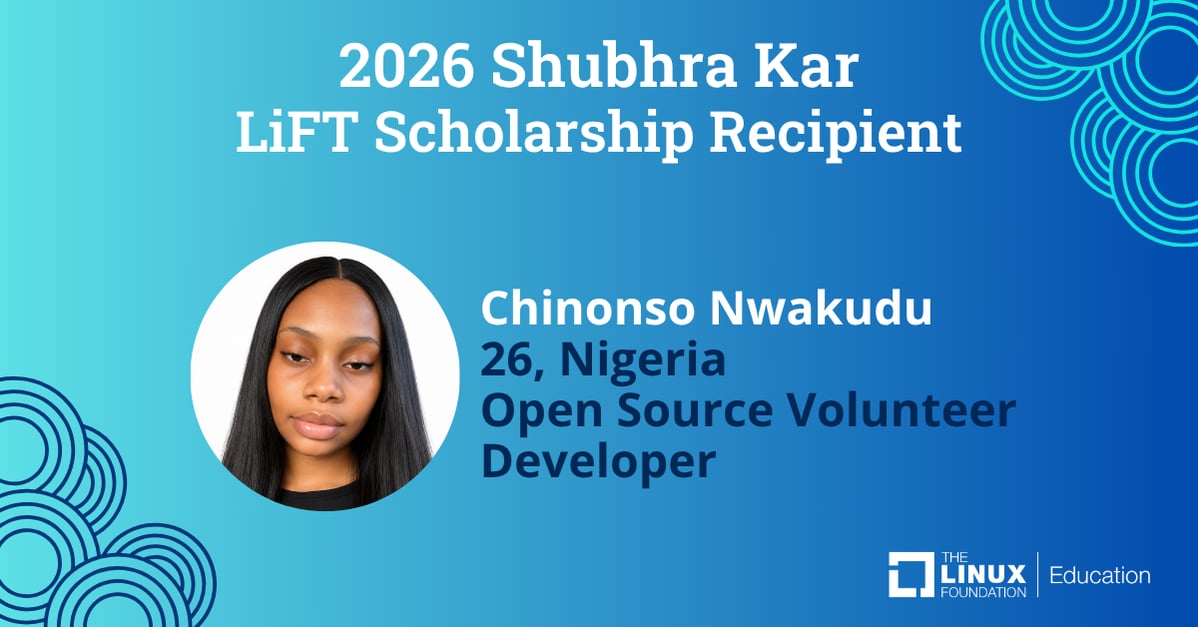
Chinonso Nwakudu, 26, Nigeria
Open Source Volunteer Developer
Chinonso Nwakudu is a DevOps engineer who has turned volunteer contributions into a track record across some of the most widely used open source infrastructure projects. He has merged PRs in cert-manager, Tekton, OpenTelemetry .NET, and Kubewarden, and contributed directly to the Kubernetes website. Each contribution has come with a real operational context: he holds the KCNA certification and runs production workloads on EKS and AKS.
Chinonso believes that open source is where the most serious infrastructure work happens, and staying current with it is not optional in his field. His next focus is Kubernetes security internals: how the API server handles authentication, how admission controllers work, and how to design RBAC policies that hold up in production environments.
With support from the LiFT Scholarship, Chinonso will pursue his Certified Kubernetes Administrator (CKA) certification and deepen his expertise securing the infrastructure that teams worldwide depend on.
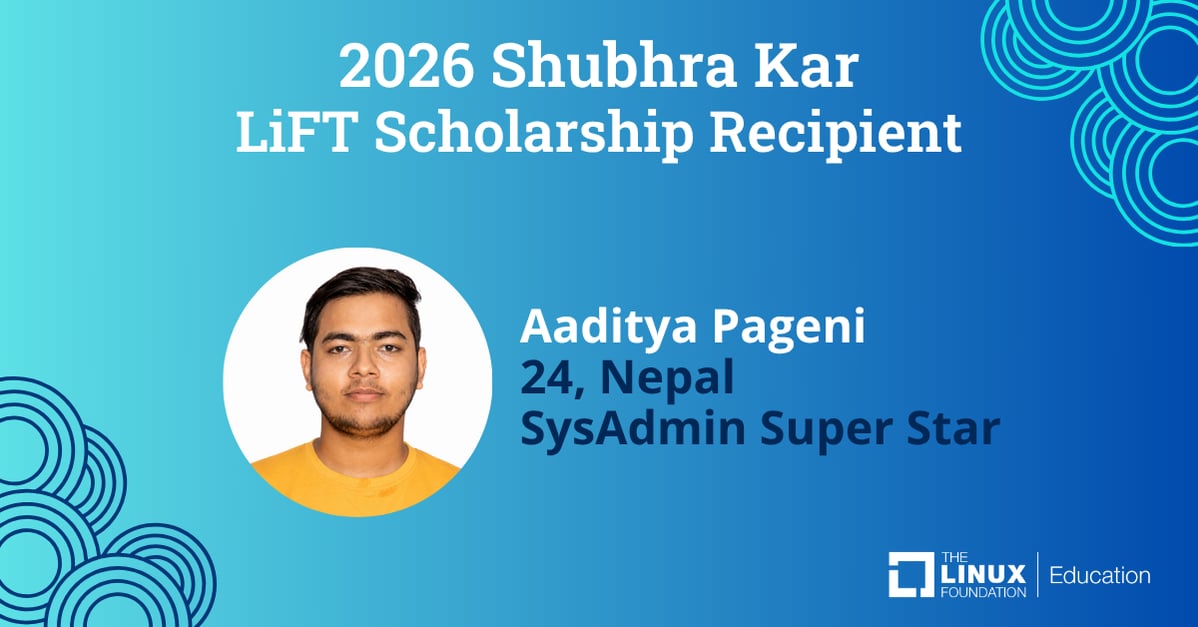
Aaditya Pageni, 24, Nepal
SysAdmin Super Star
Aaditya Pageni has been running Linux as his only operating system since eighth grade. Now an Infrastructure Engineer at StartSmall in Nepal, he works at a company that builds entirely on free and open source software, deploying OpenStack via Kolla-Ansible, managing Ceph storage clusters, and supporting customers migrating away from proprietary platforms. He's hands-on with the full stack, from bare-metal provisioning to container orchestration.
Nepal's tech sector is rapidly shifting toward open source as businesses discover that FOSS can outperform proprietary alternatives at a fraction of the cost. Aaditya sees himself as part of that shift and wants to go deeper into declarative configuration management and Cluster API to streamline and scale the OpenStack deployments his team delivers.
With support from the LiFT Scholarship, Aaditya plans to grow his expertise in Kubernetes and cloud native infrastructure and continue helping Nepal's tech sector build on open source foundations.
Rishi Mondal, 24, India
Cloud Champion
Rishi Mondal didn't plan to go this deep into open source; it just kept pulling him in. What started with small contributions grew into an LFX Mentorship at CNCF, selected from over 500 applicants, working on KubeStellar's multi-cluster Kubernetes management platform. That led to a maintainer role, where he is now responsible for the UI, backend, and infrastructure repositories of a platform used in real enterprise deployments. He is also a two-time Google Summer of Code participant and a Docker Captain.
As an SRE at Obmondo, Rishi manages Kubernetes clusters daily: cert-manager, sealed-secrets, RBAC, ArgoCD pipelines. He has realized he is mostly reacting to security issues rather than preventing them. His next goal is the Certified Kubernetes Security Specialist (CKS) certification, which will give him the formal grounding to move from responder to architect on cluster security.
With support from the LiFT Scholarship, Rishi will take the Kubernetes Security Essentials (LFS460) course, pursue his CKS certification, and continue his work as a KubeStellar maintainer in the CNCF ecosystem.
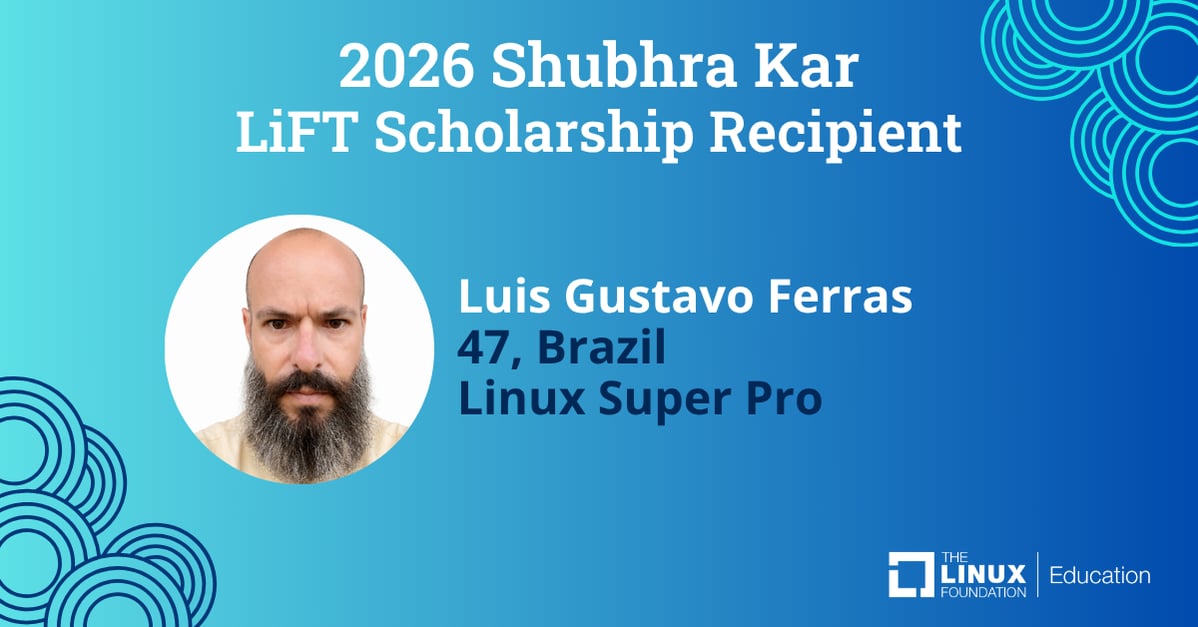
Luis Gustavo Ferras, 47, Brazil
Linux Super Pro
Luis Gustavo Ferras has built his entire 20-year career in IT on open source. From Sao Paulo, he runs a managed services operation where every client's critical infrastructure depends on Linux, including Ubuntu Server, Docker, WireGuard, Zabbix, Grafana, NGINX, and ChirpStack. He manages distributed systems spanning on-premises servers, cloud environments, and IoT gateways, and has solved production problems that required understanding Linux at the kernel level, from post-quantum key exchange MTU mismatches to routing asymmetry in multi-homed environments.
Now focused on the deepest layers of the stack, Luis wants to master eBPF for kernel-level observability and networking, OpenTelemetry for distributed tracing, and the Linux networking internals that underpin everything he builds. He sees this not as career advancement but as the natural next step for someone who has spent two decades depending on these systems professionally.
With support from the LiFT Scholarship, Luis will deepen his mastery of Linux internals and continue building the open source infrastructure that businesses across Brazil rely on every day.
Muhammad Arham Nasir, 24, Pakistan
Networking Innovator
Muhammad Arham Nasir led an eight-engineer team at xFlow Research to build a production-ready software-defined Network Packet Broker on SONiC, replacing expensive proprietary hardware and saving a customer $200,000 in monitoring costs after a successful live proof of concept. He programmed at the ASIC level using Broadcom Trident3, upstreamed a Hardware Landscape Document to the Linux Foundation SONiC project, and architected the system using a decoupled, event-driven design for high-throughput traffic analysis.
Arham is motivated by a belief that open source networking can give teams in Pakistan and across the developing world access to enterprise-grade infrastructure that proprietary vendors put out of reach. His next focus is eBPF-based kernel networking and cloud-native infrastructure with Kubernetes, to expand what's possible with software-defined, white-box solutions.
With support from the LiFT Scholarship, Arham will pursue his Certified Kubernetes Administrator (CKA) certification and continue building open source networking solutions for teams that can't afford the proprietary alternative.
Paul Panashe Munatsi, 27, Zimbabwe
Cybersecurity Defender
Paul Panashe Munatsi works at the Digital Society of Africa, where his job is to protect some of the most vulnerable people on the internet: journalists, activists, LGBTIQ organizers, and whistleblowers operating in high-risk environments across Africa. He analyzes potentially compromised devices and deploys open source forensic tools to detect and investigate threats from well-resourced adversaries. He has supported more than 70 civil society organizations with digital security.
Paul came to open source practically: he started by building and maintaining nine websites for community organizations using WordPress, YunoHost, Python, and Bash, automation to keep critical tools running for teams with little capacity to spare. Now he wants to go deeper into open source threat intelligence tooling, specifically forensic analysis and network traffic investigation for endpoint defense.
With support from the LiFT Scholarship, Paul will strengthen his cybersecurity expertise and continue building the open source defenses that help civil society organizations protect the communities they serve.
Sarthak Bhardwaj, 23, India
AI Platform Stack Innovator
Sarthak Bhardwaj is an AI Engineer at Beatroute who ships production AI agents and finds real vulnerabilities in open source AI infrastructure. Last quarter he built a multi-VLM merchandising audit agent, solving a stochastic overcounting problem in frontier vision models through a seven-arm methodology ablation and a o/u < 0.05 acceptance gate. In parallel, he has discovered four CVEs across crewAI, BentoML, aibrix, and FastChat, including an unauthenticated directory deletion vulnerability in aibrix, and has merged upstream PRs in Apache Airflow, dbt-core, and two Indian civic tech platforms.
Sarthak wants to become a trusted independent maintainer of infrastructure that ends up in real dependency graphs, earning income directly from companies whose security teams rely on his judgment. To get there, he's focused on cloud-native security at the Kubernetes control plane level, the layer he runs every day for AI workloads but has never formally studied.
With support from the LiFT Scholarship, Sarthak will pursue his Certified Kubernetes Security Specialist (CKS) certification and continue his work at the intersection of AI systems engineering and open source security research.
Karim Fouad, 40, Egypt
Digital Trust Innovator
Karim Fouad is a Data Architect working in cloud and security at Borg El-Arab University Hospital's Pediatric Oncology Center in Alexandria. He has spent over a decade building secure, reliable infrastructure on Linux, managing Ubuntu, Debian, Rocky Linux, and AlmaLinux environments, building automation with shell scripting, and implementing security configurations for sensitive healthcare systems. His work has delivered measurable results: a 50% improvement in infrastructure reliability for an environment where downtime has direct patient consequences.
Karim's goal is to design and implement a secure open source platform that improves coordination and human experience in healthcare environments. That means advancing his knowledge in Kubernetes security zero trust architecture, and blockchain-backed systems for digital identity, technologies he sees as essential for building trustworthy infrastructure in one of the highest-stakes environments imaginable.
With support from the LiFT Scholarship, Karim will advance his expertise in Kubernetes security and Blockchain & Decentralized Identity technologies, and continue building open source systems that protect patients and the people who care for them.
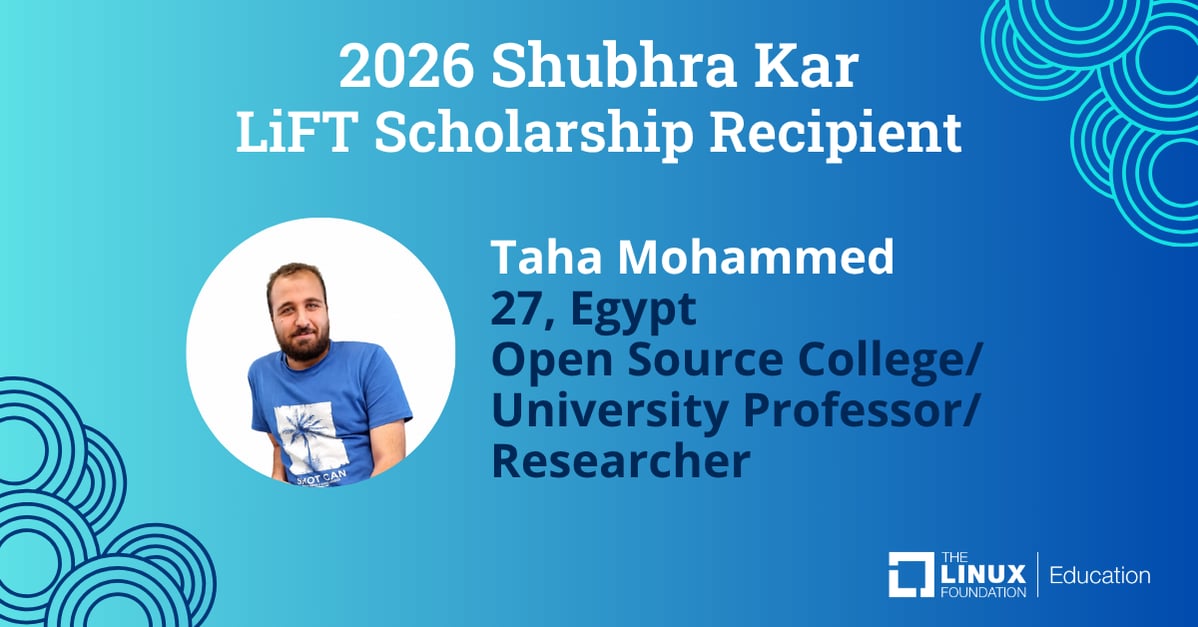
Taha Mohammed, 27, Egypt
Open Source College/University Professor/Researcher
Taha Mohammed is an SRE at a YC-backed startup and a Master's researcher in Computer and Control Engineering at Tanta University, where his academic work focuses on next-generation container runtimes. He benchmarks Firecracker, gVisor, and WebAssembly side by side, generating empirical data on the trade-offs between hardware-level virtualization and process-based sandboxing that helps the open source community make better architectural decisions at scale.
His open source contributions match his research in depth. He identified a critical compliance logic failure in OpenSSL 3.5.5 regarding HMAC key strength enforcement (Issue #30012), which led to official patches by the OpenSSL team. He has also architected a FIPS 140-3 compliant Java runtime called Wolfi Java FIPS, achieving SLSA Level 3 compliance and a zero-CVE footprint, and engineered a Python-based Buildpack Shim to automate FIPS compliance at the JVM level.
With support from the LiFT Scholarship, Taha will pursue his Certified Kubernetes Security Specialist (CKS) certification and continue bridging academic research and production open source security in the cloud-native ecosystem.
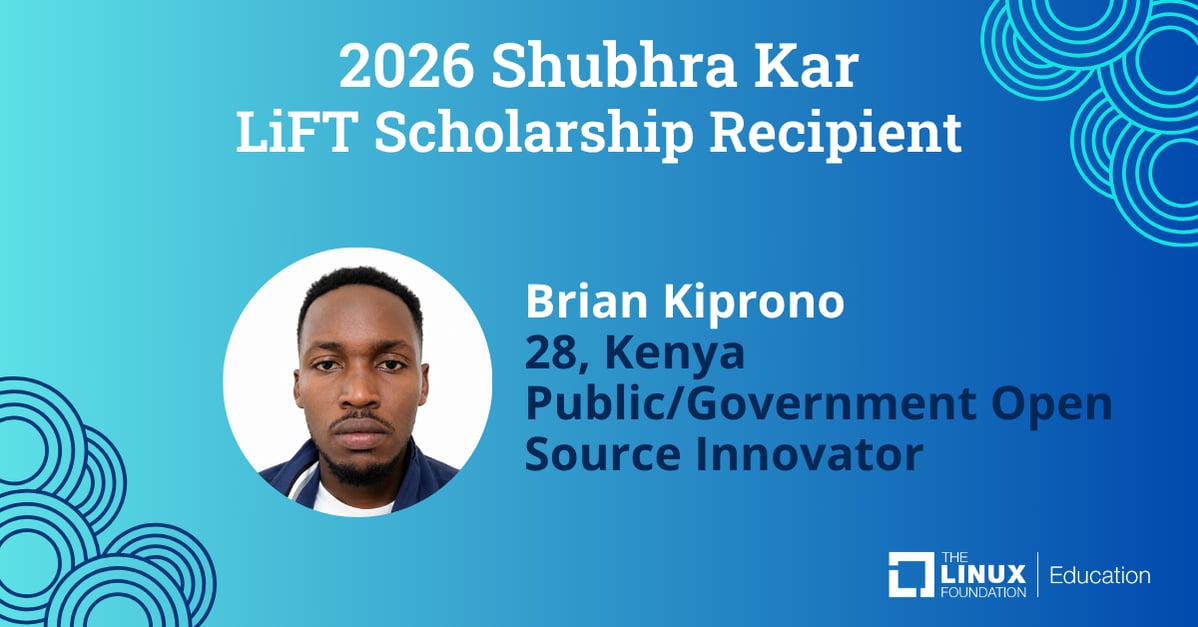
Brian Kiprono, 28, Kenya
Public/Government Open Source Innovator
Brian Kiprono is an Electrical Engineer interning at KETRACO, Kenya's national energy transmission company, where he is building a data pipeline to aggregate sensor data across power corridors for smart grid operations. Open source is not an option for this work; it is the only viable path. He is pursuing an MSc in Big Data Technology at UNICAF/UEL alongside his engineering role, applying Kubernetes, Kafka, and data engineering tools to a problem with direct national infrastructure consequences.
Brian's ambition is to bring modern data architecture to public-sector infrastructure in Kenya, where the gap between what is needed and what proprietary vendors make accessible is widest. He wants to go deep on Kubernetes cluster administration: CNI plugins, cluster health management, and persistent storage, to build reliable, scalable pipelines that can support grid observability across an entire country.
With support from the LiFT Scholarship, Brian will pursue his Certified Kubernetes Administrator (CKA) certification and continue developing open source data infrastructure in service of Kenya's public sector.
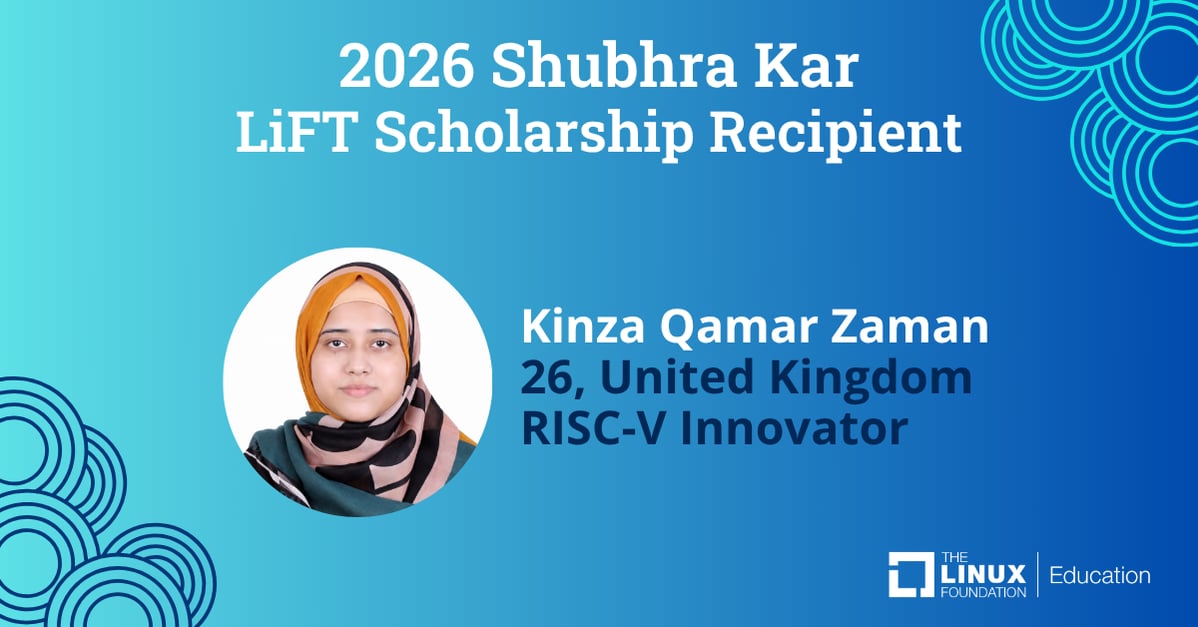
Kinza Qamar Zaman, 26, United Kingdom
RISC-V Innovator
Kinza Qamar Zaman is a Design Verification Engineer at lowRISC, where she verifies the open source Ibex and OpenTitan RISC-V cores used in real silicon. Working on chips designed to be transparent, auditable, and free from proprietary constraints, she experiences first-hand why open source hardware matters: when something breaks at a critical deadline, the community fixes it in hours rather than waiting on a vendor license or support ticket.
Kinza wants to advance her expertise in open source formal verification frameworks and EDA tooling, replacing the expensive proprietary tools that create bottlenecks for DV engineers with open alternatives that can be trusted, extended, and shared. She sees open source as the only realistic path to breaking the license-cost and vendor-dependency problems that slow hardware development across the industry.
With support from the LiFT Scholarship, Kinza will grow her formal verification skills and continue her work on the open source silicon that underpins some of the most security-critical hardware in the RISC-V ecosystem.
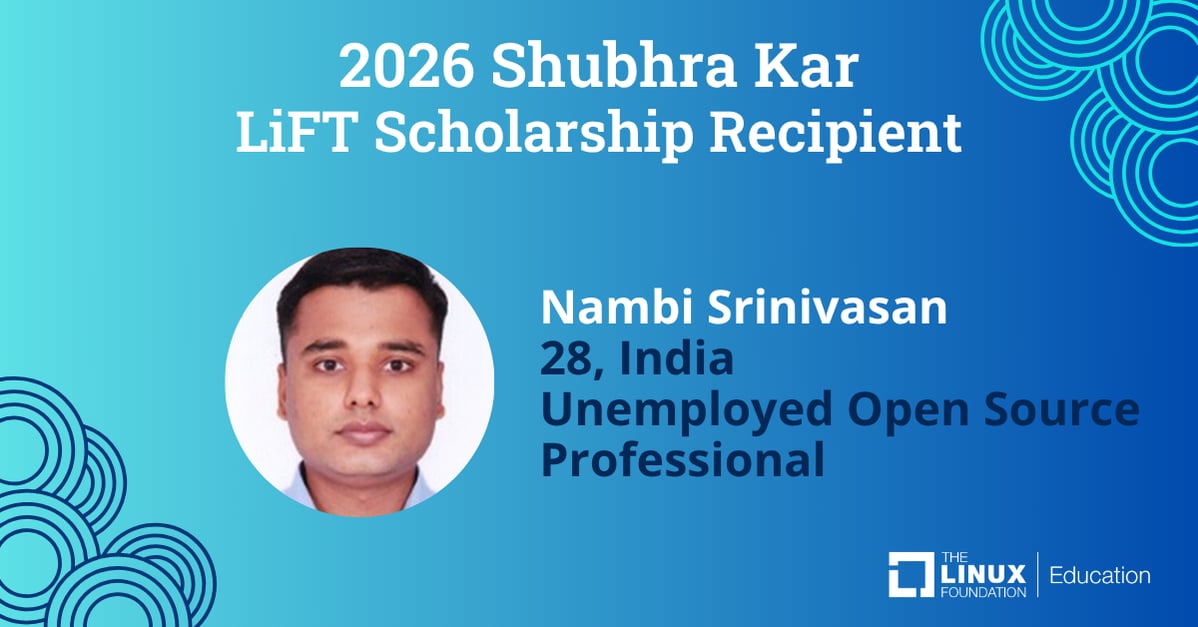
Nambi Srinivasan, 28, India
Unemployed Open Source Professional
Nambi Srinivasan resigned from IBM in early 2026 to care for his father. A Senior Platform Engineer with seven years of experience across Cognizant, Bosch, Intel, and IBM, working with Kubernetes, Terraform, Jenkins, GitLab, and confidential computing platforms, he went from leading production infrastructure to managing hospital appointments and medical bills. Through it all, he never fully disconnected from open source. He already holds the Kubernetes and Cloud Native Security Associate (KCSA) certification from the Linux Foundation.
Nambi knows the difference between holding a certification and truly mastering a domain. He wants to go deeper into Kubernetes security in production: how to design RBAC policies, harden clusters against real threats, and apply the confidential computing knowledge he built at Intel's Trust Authority platform to cloud-native security architecture.
With support from the LiFT Scholarship, Nambi will pursue his Certified Kubernetes Security Specialist (CKS) certification and take the next step toward rebuilding the open source career he has spent seven years earning.