
The Linux Foundation | 05 December 2025
 New AGL SoDeV reference platform supports ECU consolidation, virtualization, hardware abstraction and cloud integration for next-generation vehicles.
Highlights:
- AGL SoDeV is an open source reference platform for software defined vehicles enabling software-first development, independent of hardware constraints.
- The initiative is led by Panasonic Automotive Systems, Honda, and the AGL SDV Expert Group, with contributions from Toyota, Mazda, AISIN and Renesas.
- SoDeV integrates the AGL Unified Code Base with key open source projects including Linux Containers, VirtIO, Xen, Yocto Project, Zephyr and ELISA.
- Availability is planned for early 2026 for virtual environments, cloud processors and automotive SoCs.
SAN FRANCISCO, December 5, 2025 – Automotive Grade Linux (AGL), a collaborative cross-industry effort developing an open source platform for connected car technologies, today announced SoDeV, a new open source SDV reference implementation that enables software-first development, decoupled from hardware constraints.
Led by Panasonic Automotive Systems, Honda and the AGL Software Defined Vehicle (SDV) Expert Group, SoDeV combines the AGL Unified Code Base (UCB) with multiple open source projects hosted by the Linux Foundation to support consolidation of ECUs, hardware abstraction using virtualization, and cloud integration for next-generation vehicles. Additional contributors to SoDeV include Toyota, Mazda, AISIN and Renesas.
“There are many key open source components that are required to build a modern Software Defined Vehicle architecture and most of them are hosted at Linux Foundation,” said Dan Cauchy, Executive Director, Automotive Grade Linux. “SoDeV combines AGL’s proven Unified Code Base with Linux containers, VirtIO, Xen hypervisor and Zephyr RTOS, all in a single pre-integrated downloadable package that can run on real hardware SOCs or cloud-based processors. Up until now, developers had to do all this complex integration themselves. SoDeV serves as a catalyst for the community to build and deploy SDV technologies much faster.”
“Open collaboration is essential to drive the future of Software Defined Vehicles,” said Kazuo Tsubouchi, Executive Chief Engineer, Honda Motor Co., Ltd. “AGL SoDeV provides a flexible platform that OEMs can use as a foundation to develop modern in-vehicle architectures, streamline software consolidation, and simplify updates across multiple vehicle generations. It also enables rapid adoption of new technologies, and we believe this approach will enhance the overall value of the car.”
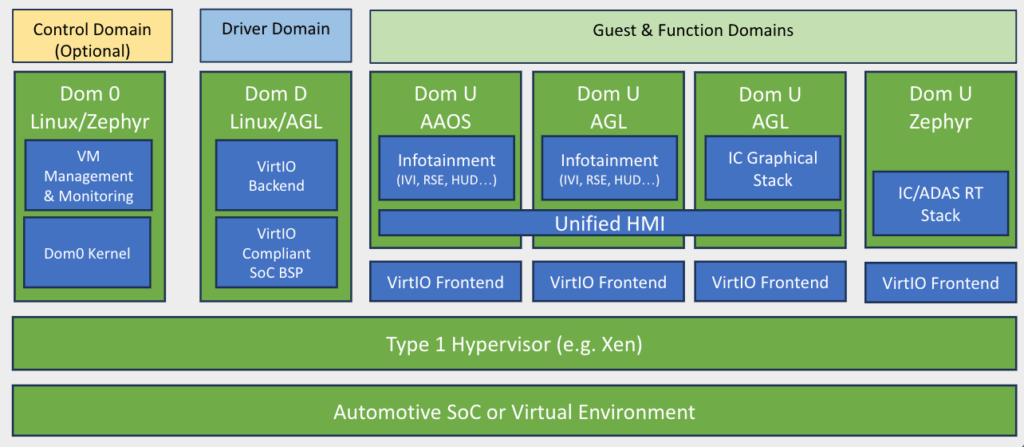
AGL SoDeV provides an SDV reference architecture and environment to build multiple components in a single downloadable package. Key open source components of the AGL SoDeV Reference Platform include:
- AGL Unified Code Base (UCB): The industry’s de facto Linux-based open source platform for infotainment, instrument cluster and telematics.
- Linux Containers: A lightweight, efficient way to run applications in isolated environments on a shared Linux system, allowing for multiple functions such as Instrument Cluster and Infotainment to run on the same processor.
- Unified HMI: A flexible multi-display virtualization framework contributed to AGL by Panasonic Automotive Systems.
- VirtIO: An common interface for device virtualization standardized by OASIS and in the Linux Kernel for decoupling software from hardware for flexible deployment across vehicle variants.
- Xen: A widely-used open-source Type 1 hypervisor hosted at the Linux Foundation.
- Yocto Project: An open-source toolkit at the Linux Foundation that enables developers to build custom Linux for embedded systems.
- Zephyr: A Linux Foundation project that provides a secure, modular open-source RTOS for IoT and embedded systems.
- ELISA Project: AGL is collaborating with the Linux Foundation’s ELISA Project to support future ASIL Functional Safety applications within SoDeV.
“The automotive industry needs open, interoperable solutions to achieve the promise of software-defined architectures,” said Masashige Mizuyama, Executive Vice President, Chief Technology Officer (CTO) at Panasonic Automotive Systems. “By leveraging technologies such as Unified HMI, VirtIO-based device virtualization and open hypervisors, the AGL SoDeV reference platform decouples software implementation from the hardware requirements. This allows software development teams to continuously work on the platform independent of current and future hardware availability.”
SoDeV will be available for virtual environments, cloud-based processors and automotive SOCs such as the AGL Reference hardware in early 2026.
The SoDeV architecture will be discussed further at the upcoming Automotive Linux Summit in Tokyo on December 8-10, 2025, where Dan Cauchy, Executive Director of AGL, will be giving a keynote and AGL SDV Expert Group members will show demos, outlining technical milestones and opportunities for community contribution.
Additional details about SoDeV and how to get involved are available here.
###
About Automotive Grade Linux (AGL)
Automotive Grade Linux (AGL) is the leading open source platform for Software-Defined Vehicles (SDV), empowering automakers to deliver new features, updates, and user experiences over-the-air while accelerating the shift to software-centric vehicle architectures. AGL is a Linux Foundation Collaborative Project that unites automakers, suppliers, and technology companies to create a single, shared software stack for infotainment, instrument clusters, telematics, and other in-vehicle systems. By reducing fragmentation and fostering collaboration across the industry, AGL speeds development and time to market, driving innovation at the heart of the connected and software-defined vehicle ecosystem.
Media Contact:
Emily Olin
Automotive Grade Linux
pr@automotivelinux.org