
4 MIN READ
Hilary Carter | 28 August 2026
At the Linux Foundation, our community thrives because of the dedicated work of developers, project maintainers, enterprise partners, platform engineers, and generous sponsors worldwide. On behalf of the team at LF Research, I want to extend our heartfelt thanks to all of our global sponsors and partners whose continued support makes our research, open source initiatives, and educational programs possible.
Following KubeCon/CloudNativeCon Japan last month, Clyde Seepersad, Senior Vice President and General Manager of Linux Foundation Education, and I each gave a presentation in Tokyo rooted in recent research. Clyde’s talk described emerging trends unfolding across the Japanese tech talent ecosystem. Amid global conversations around automation and AI-driven efficiency, Japan stands out for its commitment to workforce development. While headlines elsewhere focus on potential job displacement, new research reveals that Japan leads globally in entry level hiring and structured onboarding. However, as AI adoption accelerates, Japan has a critical opportunity to build on this foundational strength by expanding continuous training across all seniority levels.
Our recent research publication, the 2026 State of Tech Talent Japan Report: Expanding Headcount and Closing the Skills Gap to Modernize Japan's Infrastructure, provides a comprehensive look at how Japanese organizations are navigating AI integration, infrastructure modernization, and talent retention.
Here is the story behind the data and what it means for the future of open source and enterprise technology in Japan.
AI creates jobs, but reveals a full-stack readiness challenge
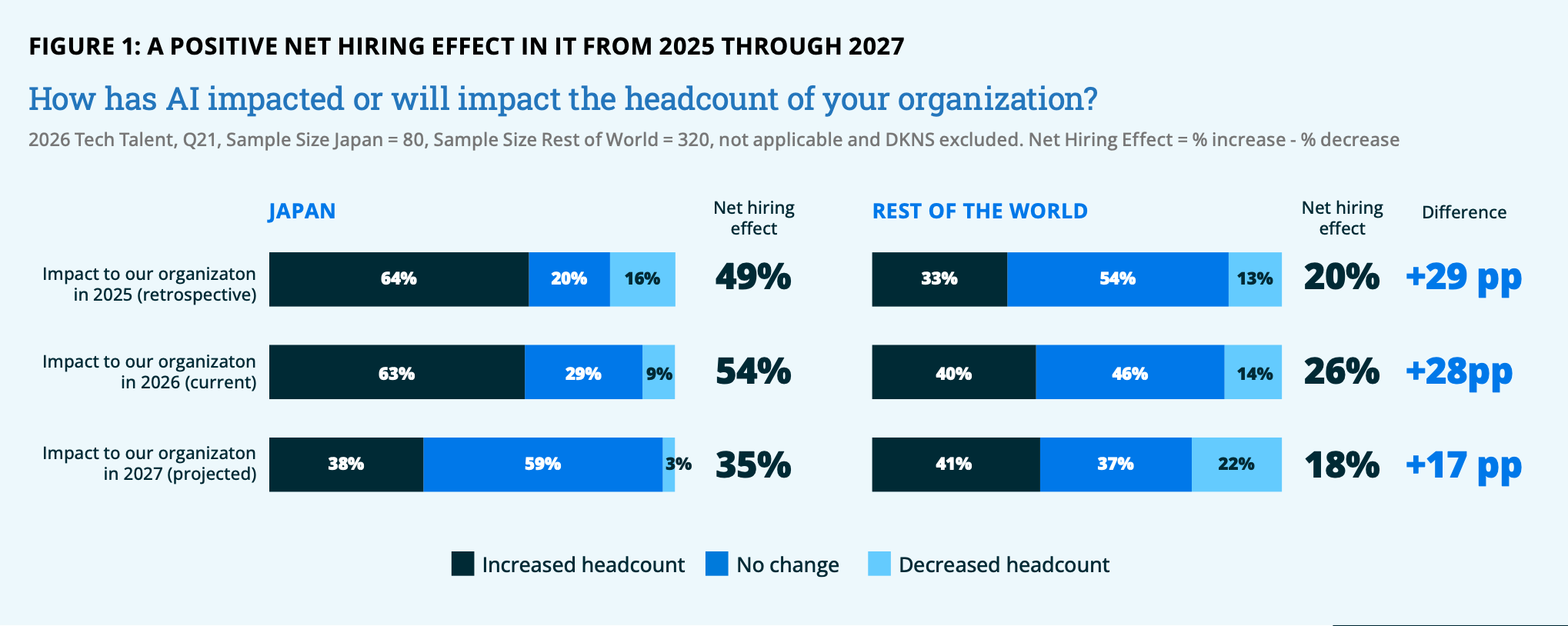
A common worry surrounding artificial intelligence is that automation will shrink technical teams. The report demonstrates that the reality in Japan is quite the opposite. AI is serving as a strong net driver of job creation across Japan's IT sector, with net hiring growth rates projected at +54% in 2026 and +35% in 2027—substantially higher than global averages.
The entry level edge: Building pipelines from the ground up
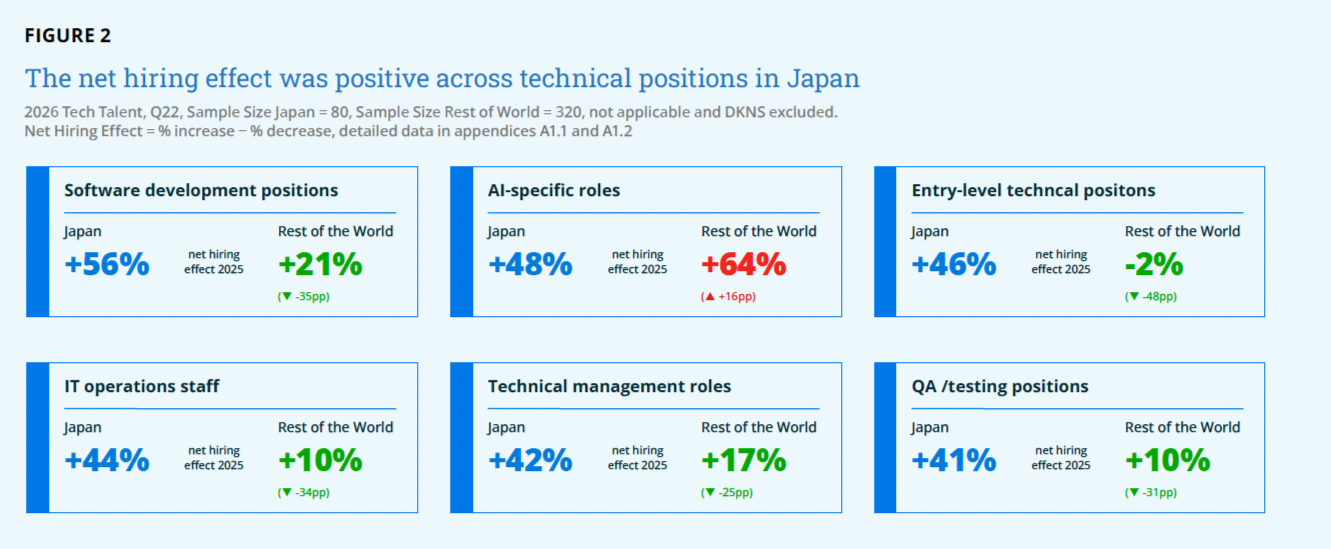
One of the most encouraging findings from the report is Japan's unique approach to early career talent. While the rest of the world shows a negative net hiring effect for entry level technical roles (-2%), Japan shows a strongly positive net hiring effect of +46%.
This reflects a long-standing cultural strength in Japanese employment practices: bringing in promising talent, teaching them core business context, and developing their skill sets over time. When Clyde shared these insights with attendees in Tokyo, the resonance was clear. Japan’s ability to onboard junior engineers provides a solid base. To fully realize the benefits of modern technologies like cloud native computing, AI operations, and cybersecurity, this investment in learning must extend seamlessly to mid-career and senior engineers as well.
Bridging the gap in infrastructure and DevOps
Despite enthusiasm for AI, the report highlights significant capability gaps across critical infrastructure domains. Only 13% of Japanese organizations currently maintain dedicated AI and ML technical headcount, compared to 53% globally. The gap is even more pronounced in DevOps, CI/CD, and site reliability engineering, where only 18% of Japanese organizations have dedicated staff compared to 68% worldwide.
Furthermore, when asked about top barriers to realizing value from AI, Japanese organizations ranked a lack of infrastructure skills first (29%), whereas global peers cited security concerns as their primary obstacle. Without robust cloud, container, and SRE foundations, scaling AI workloads into reliable production systems remains difficult.
Why upskilling beats hiring for long-term growth
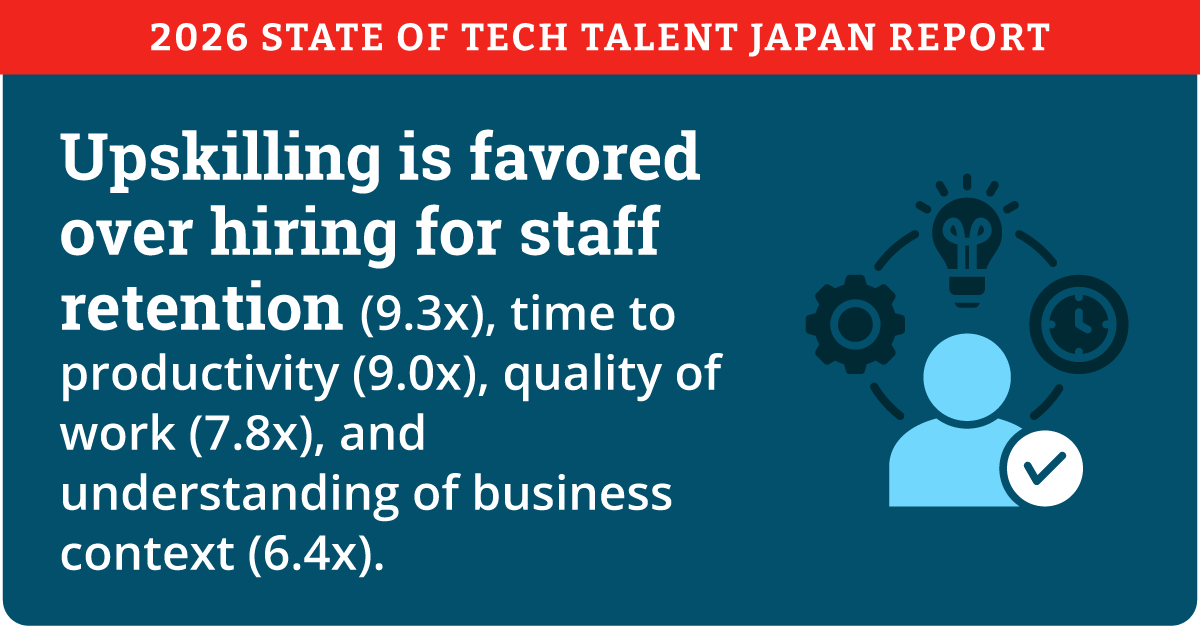
To bridge these skill gaps, Japanese enterprises are turning inward. The report shows that 54% of Japanese organizations prioritize hiring inexperienced professionals and upskilling them as their primary talent strategy. Across strategic technology domains, organizations are on average 9.3 times more likely to upskill existing employees than to hire externally.
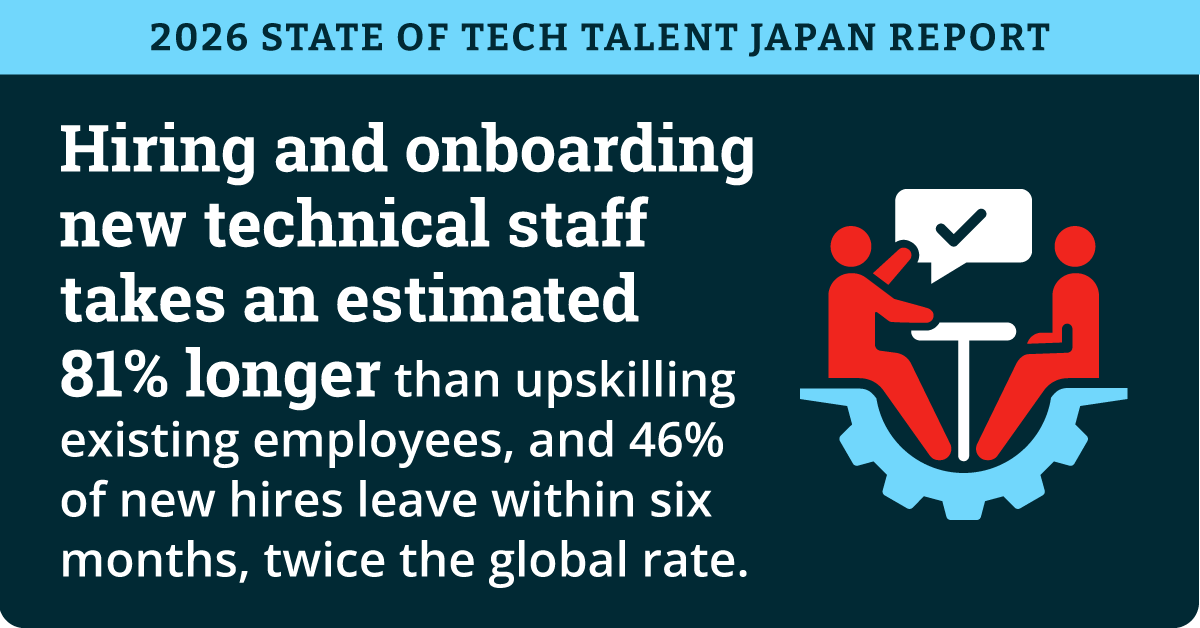
This preference is grounded in practical economics and retention. The report reveals that hiring and onboarding new technical staff in Japan takes 81% longer than upskilling existing team members. Moreover, 46% of new external hires leave within six months—twice the global rate. By contrast, internal team members already understand the business domain and institutional culture, leading to higher quality work, faster time to productivity, and stronger staff retention.
When comparing workforce strategies directly, organizations report that upskilling outperforms hiring across every major operational measure, including quality of work, team cohesion, and overall retention.
Empowering tech talent across every career stage
Closing the skills gap requires sustained commitment across the entire open source ecosystem. For hiring managers and executive leaders, the report offers actionable takeaways:
- Invest in continuous internal training: Expand upskilling pathways beyond entry level onboarding to support senior and mid-level engineers as technologies evolve.
- Prioritize full-stack capability: Align training programs with cloud native infrastructure, container orchestration, DevOps, and AI security.
- Foster an open source culture: Granting dedicated open source contribution time and maintaining clear open source policies ranks second among effective retention strategies in Japan (88%), placing it above traditional compensation.
At the Linux Foundation, we remain dedicated to providing vendor-neutral certifications, training frameworks, and community programs that empower organizations and individuals alike. By building on Japan's established leadership in talent development and expanding training across every level of seniority, the technical community can successfully modernize infrastructure and unlock the full potential of AI.
Discover our library of insights
To read the complete findings, methodology, and detailed domain analysis, download your free copy of the 2026 State of Tech Talent Japan Report: Expanding Headcount and Closing the Skills Gap to Modernize Japan's Infrastructure.