
4 MIN READ
Hilary Carter | 06 October 2026
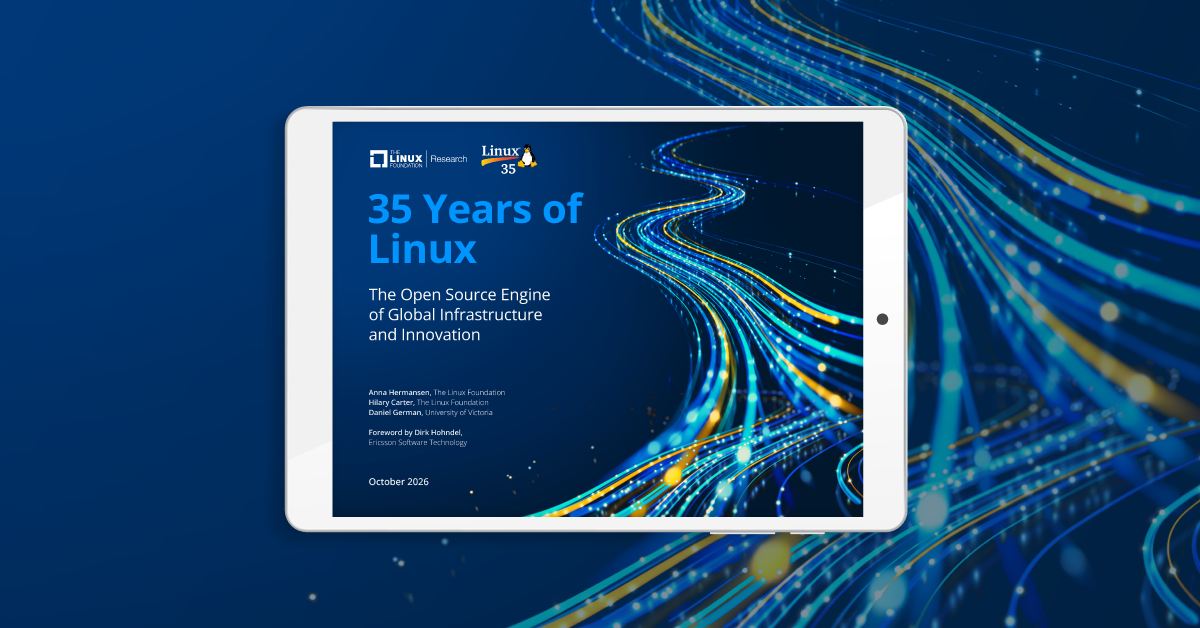
Thirty-five years ago, a modest post on a newsgroup announced a hobby project that would forever change the landscape of modern technology. Today, we are thrilled to reflect on the impact of the Linux kernel as we share our newest report, 35 Years of Linux: The Open Source Engine of Global Infrastructure and Innovation. From underpinning the cloud to powering outer space missions, the Linux kernel has proven to be an unstoppable engine for economic growth and technical progress. And thanks to the insights from more than a dozen active contributors to the Linux kernel and numerous open source project leaders, and of course, Linus Torvalds himself, this report tells a rich story of how far the kernel has come and where it’s going on the occasion of this milestone anniversary.

The history of the Linux kernel and its development milestones are astounding. At the same time, we wanted this report to illustrate how the kernel has impacted the open source community, the innovation posture of global industries who rely on open source for their operational and differentiated technologies, as well as the societal impacts of the kernel that has made so much of our day to day possible. Today, the kernel continues to serve as the runtime for modern software workloads while constantly evolving to meet future computing needs.
Its value is so much more than lines of code. Working on the Linux kernel provided developers with a model for collaboration to build and contribute to so many different open source software projects. This collaborative ethos extends beyond open source code to domains like open hardware and open data and underpins our digital economy: for example, if open source software were eliminated, global GDP for the average nation would be over 2% lower in the long run. Here are just a few of the headlines from our report:
From hobby project to global powerhouse
The proliferation of the Linux kernel from its earliest days to the most consequential open source project in the world is felt through its ubiquity across technology and industry domains, from local edge devices to massive supercomputers.
As of today, Linux powers 4 billion Android devices, 30 million Chromebooks annually, 200 million-plus servers, and all of the top 500 supercomputers. From automotive software stacks to mission-critical trading platforms in financial services, industries rely on the security, transparency, and adaptability of the kernel.
Engineering practices and continuous contributor velocity
Additionally, the report describes how kernel development revolutionized software engineering practices by pioneering review-driven collaboration and the use of Git, another high-impact Torvards invention. Today, the kernel sees nearly ten changes happening every hour, with a new release taking place predictably every eight to nine weeks.
Despite being 35 years into its evolution, the community remains vibrant, healthy, and growing. The kernel continues to break records for engaging new talent, particularly in the number of first-time code contributions through the 7.0-7.2 kernel releases. Contributor diversity and retention is also strong, with over 100 contributors making up 50% of contributions and over 50% of contributors remaining actively engaged over quarters. The developer ecosystem is as dynamic and active as ever!
Pioneering real-time capabilities and the frontier of AI
As technology landscapes shift, Linux evolves alongside them. The mainlining of built-in real-time support (PREEMPT_RT) in kernel 6.12 represents the culmination of a twenty-year community effort, unlocking new potential for industrial robotics, automotive systems, and latency-sensitive edge environments. Furthermore, the kernel is now adapting to power compute-intensive parallelized AI workloads while simultaneously using AI tooling to assist maintainers with patch reviews and security auditing.
We would be remiss if we did not thank our co-author, Daniel German of the University of Victoria (which makes this report authorship a true Canadian hattrick), for his guidance and leadership, in particular regarding the history of Linux kernel development, and Dirk Hohndel of Ericsson, for his contribution of the report foreword.
As we look toward the future, ensuring the sustainability of open source software through mentorship, security initiatives, and community support remains at the core of our mission. We invite you to dive into the full report to explore these data insights and historical milestones in depth.
To read the full report and explore our complete library of data-driven open source insights, please visit our research collection at https://www.linuxfoundation.org/research.