
8 MIN READ
Nithya Ruff | 07 July 2026
This is the first in a four-part series on open source and academia from Linux Foundation board chair, Nithya Ruff.
I was fortunate enough to recently give a speech at the University of California at Berkeley on the role and importance of academia in the rise of open source software. The setting could not have been more relevant. Perhaps more than any other academic institution, Berkeley has birthed critical open source projects and technologies. Berkeley Software Distribution (BSD) was the precursor to FreeBSD and multiple other open source operating systems. BSD’s networking stack, TCP/IP, became the open source core of the Internet. The open source RISC-V semiconductor instruction set, the Apache Spark data analytics engine, and the Ray distributed AI orchestration system all emerged from Berkely.
The story of Berkeley is today the story of the software and technology universe. Today, open source software sits beneath virtually every piece of modern technology infrastructure, and much of it traces its origins to university labs. In fact, Linux itself goes back to Linus Torvalds’ work as a student at University of Helsinki. Dozens of other open source projects have followed this now well worn path. The Linux Foundation, which is home to over 1,000 projects including Linux, Kubernetes, PyTorch, and RISC-V, has become a critical bridge between academic research and production-scale reality. It is not an exaggeration to say, without innovations of academics, open source would never have succeeded to the same degree.
Yet this storied collaboration sits at a critical juncture due to the dynamics of AI. Nearly 90 percent of notable AI models in 2024 came from industry, up from about 60 percent just one year before. If anything, that number has climbed since then. About 70 percent of new AI PhDs go directly into industry, due to a massive salary gap between industry and academia for AI researchers, who can collect millions of dollars from major foundational labs and technology companies.
This exodus causes multiple problems. Innovation that formerly happened in the open is locked behind closed doors and trapped inside restrictive licenses. Perhaps more troubling, this shift away from academe creates a daunting pipeline problem. The universities train the people who build AI and lose them before a public-interest perspective takes root in their work. Fewer and less experienced professors means less opportunities for undergraduate and graduate students to learn from leading AI thinkers. Also troubling, as AI occupies a more and more central role in technology development and software evolution, the loss of this talent means that the future will be more strongly influenced by institutions that operate primarily on a profit motive rather than by researchers who build technology for the sake of solving problems and experimentation.
To be clear, academic institutions and the people who work are active in the standards bodies and discussions about how to regulate and shape AI. While this is important, it does not make up for the dwindling number of AI researchers in academia and the longer term deleterious effects of AI moving from an open ecosystem into a closed ecosystem.
This series of articles explores the important history of open source work in academia and the unique and critical role of academic institutions for the fair and democratic development of AI technologies. It then explains how researchers and students can participate in open source foundations, where the most impactful technology projects from academic research congregate, and why
Born in the Lab, Built for the World
Some of the most consequential Linux Foundation projects began as university research. These aren't just historical footnotes.In many cases, the academic communities that created them remain deeply involved, serving as a talent pipeline for project maintainers and playing a critical role in the formation of commercial entities to further develop projects. In the case of RISC-V, an open source standard is becoming a new global standard for semi-conductor design, expanding influence and reach dramatically in the past five years — all due to the persistence of academic teams and researchers who originally developed the work.
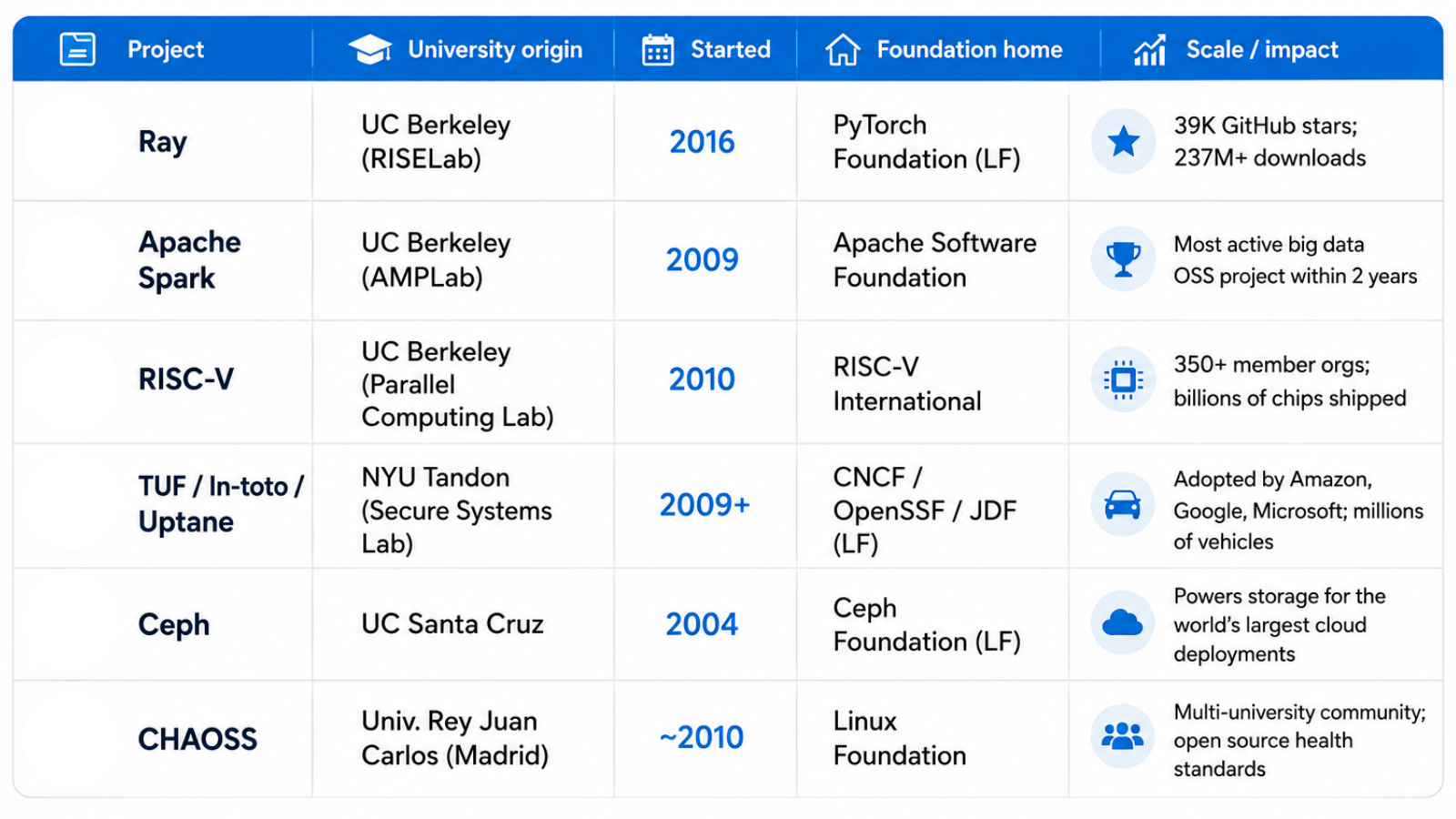
How Ray Rose From UC Berkeley to Wide AI Usage and the PyTorch Foundation.
Ray began in 2016 as a class project at UC Berkeley's RISELab, where students and researchers were trying to scale distributed neural network training and reinforcement learning. Ph.D. students Robert Nishihara and Philipp Moritz, along with professor Ion Stoica, developed the framework and went on to co-found Anyscale. In October 2025, Anyscale donated Ray to the PyTorch Foundation under the Linux Foundation, where it now forms part of the core open source AI compute stack alongside PyTorch and vLLM. Ray has amassed over 39,000 GitHub stars and more than 237 million downloads, and is used by OpenAI, Uber, Spotify, and Netflix. The RISELab, itself the successor to the AMPLab that produced Apache Spark, demonstrates how Berkeley's tradition of five-year collaborative research labs consistently produces technologies that reshape entire industries.
For a story that happened in this very institution, look no further than Apache Spark. In 2009, a UC Berkeley PhD student named Matei Zaharia began building Spark inside the AMPLab — a research lab funded by DARPA, NSF, and industry partners and home to some of the best distributed systems researchers in the world, including Ion Stoica, Michael Franklin, and a visiting scholar named Ali Ghodsi. They built something genuinely new: a unified engine for large-scale data processing that was dramatically faster than anything that existed. Then in late 2012, Ghodsi and six colleagues stood in a Berkeley conference room and faced a decision: commercialize it immediately, or open source it first. They chose open source. Spark was donated to the Apache Software Foundation in 2013 and within two years became the most active big data open source project in the world, with contributions from IBM, Intel, Yahoo, and thousands of developers they had never met. Only after that community foundation was established did Ghodsi and his co-founders launch Databricks — now valued at over $60 billion — to build the commercial layer on top. The open source decision didn't delay their success. It made it possible. The Apache Foundation provided the neutral governance that let the community trust the project enough to invest in it. That is the model. From research university to open source foundation to global standard to transformational company — and it started in a lab on this campus.
RISC-V: From a Summer Project to a Global ISA Standard.
In 2010, Professor Krste Asanović and graduate students Andrew Waterman and Yunsup Lee at UC Berkeley's Parallel Computing Laboratory set out to design a clean, open instruction set architecture (ISA). What they intended as a three-month teaching tool became RISC-V, now a global open standard with over 350 organizational members across 70 countries through RISC-V International. The graduate students went on to co-found SiFive, and Asanović and Waterman continue to shape the specification. RISC-V chips now ship in billions of devices, and universities worldwide use the architecture for both research and instruction. Berkeley's open source hardware designs, including the Rocket core and the BOOM out-of-order processor, remain active reference implementations. RISC-V is rapidly becoming a critical ISA for the next generation of semi-conductors.
Justin Cappos and the NYU Secure Systems Lab: Five Linux Foundation Projects and Counting.
Perhaps no single academic lab better illustrates the professor-to-production pipeline than the Secure Systems Lab at NYU Tandon School of Engineering, led by Professor Justin Cappos. Cappos is the creator of five Linux Foundation projects spanning three sub-foundations:
- TUF (The Update Framework): A CNCF graduated project that secures software update systems, now adopted by Amazon, Google, Microsoft, and others. TUF was the first specification and first security-focused project to graduate from CNCF — and Cappos was the first academic researcher to lead a graduated CNCF project.
- In-toto: A CNCF graduated project providing end-to-end software supply chain integrity verification, used by thousands of companies, including Datadog and Docker.
- Uptane: A Joint Development Foundation project adapting TUF for automotive over-the-air updates, now deployed across millions of vehicles.
- gittuf: An OpenSSF sandbox project bringing decentralized security enforcement to Git repositories, with Bloomberg piloting the system.
- SBOMit: Addressing software bill of materials integrity.
What makes Cappos's story especially instructive is how each project followed a similar pattern: NSF or DHS-funded research at NYU, development by Ph.D. students in the lab, publication of academic papers, and then incubation and graduation through Linux Foundation governance structures. Students like Trishank Kuppusamy (now at Datadog), Santiago Torres-Arias (now faculty at Purdue), and Aditya Sirish A Yelgundhalli have gone directly from lab work to industry roles through the open source communities their research built. In 2024, Cappos was elected to the OpenSSF Governing Board, and NYU Tandon became an associate member of the Linux Foundation based on the strength of these projects. Dr. Cappos deeply believes that academic research should be practical and benefit the world when it is released and not just a dusty paper that gets forgotten.
CEPH’ Journey from UC Santa Cruz to the Linux Foundation
Ceph is one of the cleanest examples of what the academic-to-foundation pipeline can look like at its best. Sage Weil began building Ceph as a PhD project at UC Santa Cruz in 2004, funded initially by the Department of Energy, with a simple but ambitious goal: design a massively scalable distributed storage system from first principles. He completed his dissertation in 2007, and rather than letting the research sit on a shelf, he kept building. By 2010 the Ceph client had been merged into the Linux kernel itself. Weil went on to co-found Inktank, a company built entirely around the open source project, which Red Hat acquired in 2014 — validating the technology at enterprise scale. In 2018 the Linux Foundation launched the Ceph Foundation to ensure the project had permanent neutral governance, with industry members, cloud providers, and academic contributors all at the same table. What started as one graduate student's thesis at a UC campus now underpins storage infrastructure used by some of the largest cloud deployments in the world.
CHAOSS: Measuring What Matters in Open Source Health.
The CHAOSS Project (Community Health Analytics in Open Source Software) was announced as a Linux Foundation project in 2017, but its roots go back over fifteen years to academic efforts at the Universidad Rey Juan Carlos (URJC) in Madrid, where researchers built tooling to understand how open source software is developed. Today, CHAOSS brings together an intentionally mixed community of academics and industry practitioners from institutions including the University of Nebraska at Omaha, the University of Missouri, the University of Victoria, Laval University, Polytechnique Montreal, and the University of Mons. Professors like Sean Goggins (Missouri) and Matt Germonprez (Nebraska-Omaha) have been central contributors, and the project maintains a dedicated University/Academic Working Group that develops metrics for measuring open source success in university settings.
Academic labs have consistently proven to be the fertile ground for some of the most influential open source projects in existence, transforming theoretical research into global technological infrastructure.
While this storied history highlights the immense potential of academic collaboration, the rapid acceleration of AI development is currently disrupting these foundational dynamics, forcing a re-evaluation of how innovation is cultivated and sustained. In Part Two of this series I will explore how AI innovation is prompting an exodus of academic leaders to the enterprise.
.jpg?width=165&height=165&name=Nithya%20Ruff9253-Online%20(1).jpg)