
Hilary Carter | 26 October 2026

Over the past three decades, open source communities have absorbed one massive technological shift after another: the emergence of the web, the mobile revolution, and the rise of cloud native infrastructure. Through each transition, our ecosystem adapted, strengthened its collaborative norms, and grew more resilient. Yet generative AI introduces a fundamentally distinct dynamic, directly affecting the heart of how project communities function.
To ground the ecosystem in empirical evidence about the impact of Generative AI on open source projects and developers, LF Research, together with Red Hat, Futurewei, LF AI & Data Foundation and OpenSSF, published our latest comprehensive study: Navigating Open Source Software Development in the Generative AI Era: Challenges and Opportunities for Project Communities. We extend our sincere gratitude to all of the sponsors and ecosystem partners whose vital support makes this research possible.
As part of this study’s release, I was thrilled to join a live panel discussion with Brian Proffitt, senior principal community architect at Red Hat, and our own Sam Boysel, data scientist and lead report author, (with Anni Lai), at All Things Open in Raleigh, North Carolina. AI was at the top of the All Things Open agenda, with a number of keynotes delving into topics around navigating the challenges of Generative AI and building AI agents and guardrails.
As Brian Proffitt of Red Hat shared last week, as captured in the foreword,
"The picture that emerges from this survey is neither the utopia or the apocalypse we hear bandied about in the ever-polarized media, but, rather, something more useful: a measured look at where the open source community and generative AI actually stands."
The report demonstrates that generative AI is neither a crisis nor a panacea. Instead, it functions as a methodological shift, with outcomes depending heavily on project scale, governance, and how or whether teams choose to reinvest reclaimed hours from AI’s efficiency gains.
Scale amplifies the maintainer review burden
While solo and small teams often capture immediate efficiencies from AI, the pressure mounts significantly on larger, high-visibility repositories.
For projects with more than 50 contributors, maintainer burnout has displaced code quality as the primary concern. In fact, 64% of maintainers surveyed from large projects report that AI-assisted contributions have lengthened review cycles. Reviewers increasingly evaluate submissions that appear clean at first glance, but lack architectural context, coherence, or proper testing.
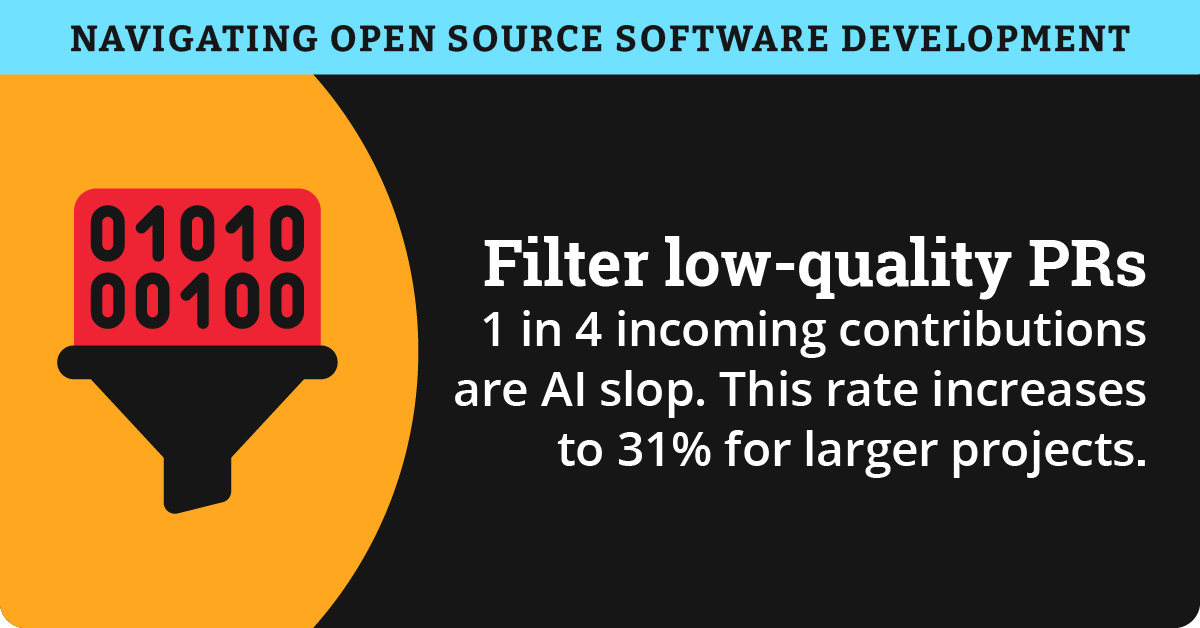
A major factor behind this review drag is the composition of incoming contributions. The report finds that an estimated 25% of incoming pull requests across all projects consist of low-quality, AI-generated submissions—often characterized as AI slop. In larger projects, that figure climbs to 31%. When maintainers must spend precious hours filtering unverified pull requests, the core human bandwidth that sustains open source infrastructure is placed under serious strain.
Bridging policy gaps and strengthening project trust
While generative AI lowers the barrier to contribution—an upside recognized by 71% of maintainers—it introduces friction regarding project trust. The report highlights that 53% of maintainers disagree that generative AI has improved community trust, with only 12% agreeing. When automated tools allow patches to be generated without deep system context, social collaboration comes under pressure.
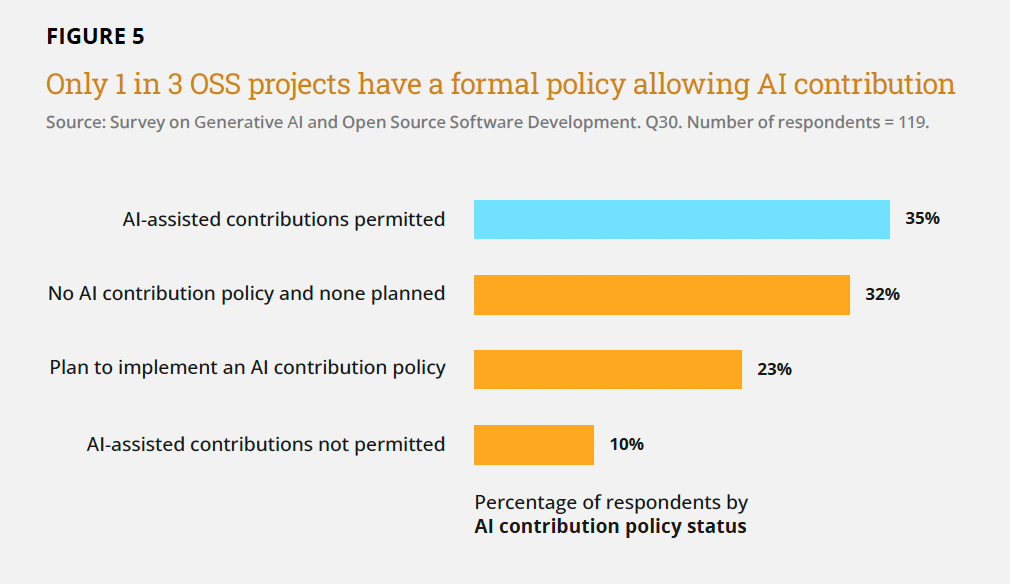
Compounding this trust gap is an absence of formal guidelines. Currently, only 35% of projects have an established policy permitting AI-assisted contributions, while 32% have no policy and none planned. The remainder either plan to implement one in the future (23%) or enforce explicit bans (10%).
Where proactive policies exist, successful communities avoid blanket bans. Instead, they focus on two core principles:
- Returning verification responsibility to contributors: Rather than expecting maintainers to debug hallucinated code, 76% of existing policies require contributors to take personal responsibility for functional testing and line-by-line review before opening a pull request.
- Standardizing transparent attribution: 76% of policies mandate clear disclosure. Establishing consistent conventions—such as the Linux kernel’s structured Assisted-by: git commit trailer—removes guesswork and fosters transparency throughout the review process.
Additionally, 77% of maintainers actively turn to AI tools themselves to summarize complex logic, catch bugs, and scan for security vulnerabilities, using the technology as an asset to protect their time.
Conscientious contributor practices and broader horizons
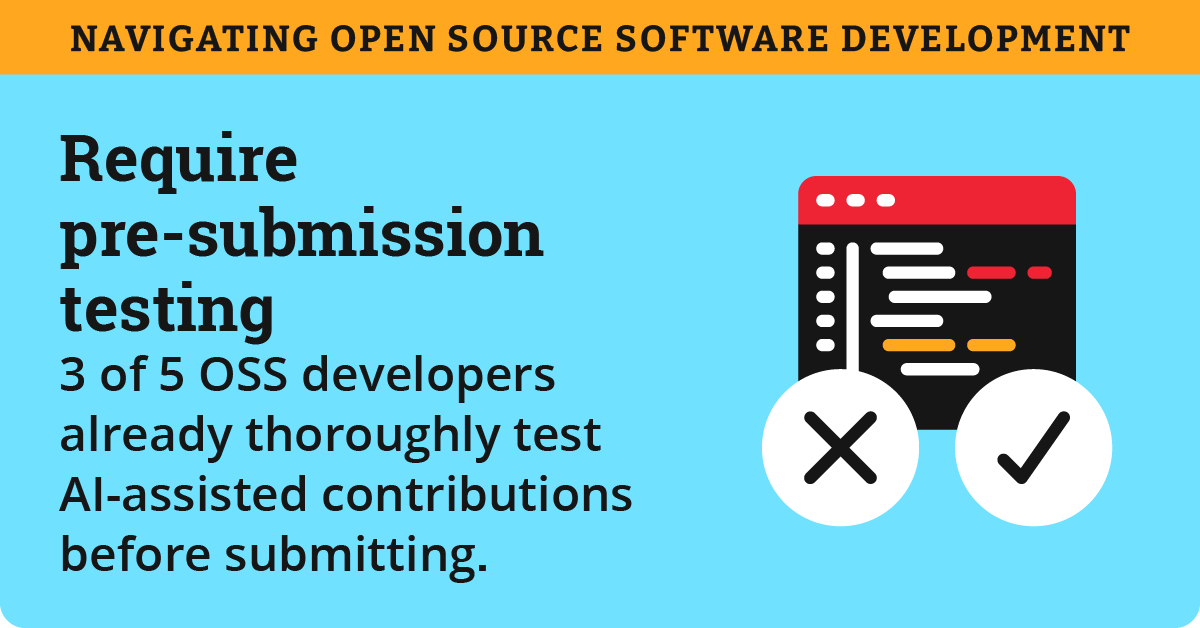
Despite common narratives that AI contributions are generated without care, the report provides evidence of conscientious adoption across contributor workflows. A full 61% of contributors perform detailed, line-by-line reviews and comprehensive functional testing on AI-assisted code prior to submission. Only 5% report applying minimal or no review.
Additionally, developers care deeply about software integrity and transparency. Four in five contributors (80%) view knowing the source model and training data lineage as important, reflecting long-standing community values around auditability and open governance.
Generative tooling also expands developer horizons. When approaching projects built with unfamiliar programming languages, frameworks, or codebases, 71% of contributors report an increased willingness to get involved, with 43% reporting a significant increase. Generative tools act as scaffolding, giving developers the confidence to step outside their comfort zones.
While the barriers to entry to open source projects are now lower, GenAi increases the need for human mentorship, with the need for contributor guidance increasing (46%) rather than diminishing it (22%). Expertise - and taste making - relating to project architecture, governance, and long-term project vision, is very much in demand.
Reinvesting productivity dividends into technical debt
When applied effectively, generative AI delivers tangible time savings across the software development lifecycle, reducing completion times anywhere from 19% to 52% depending on the task. Contributors realize their greatest savings in code authoring (-58%), while maintainers benefit most during technical discussions (-25%) and proposal evaluations (-26%).
At the same time, the report notes that productivity gains decline as task complexity rises. While 79% to 83% of developers save time on low-to-moderate complexity work, 21% report that highly complex tasks actually require more time due to diagnosing subtle errors or unraveling flawed assumptions.
Crucially, the time saved through generative AI flows directly back into the health of open source software.
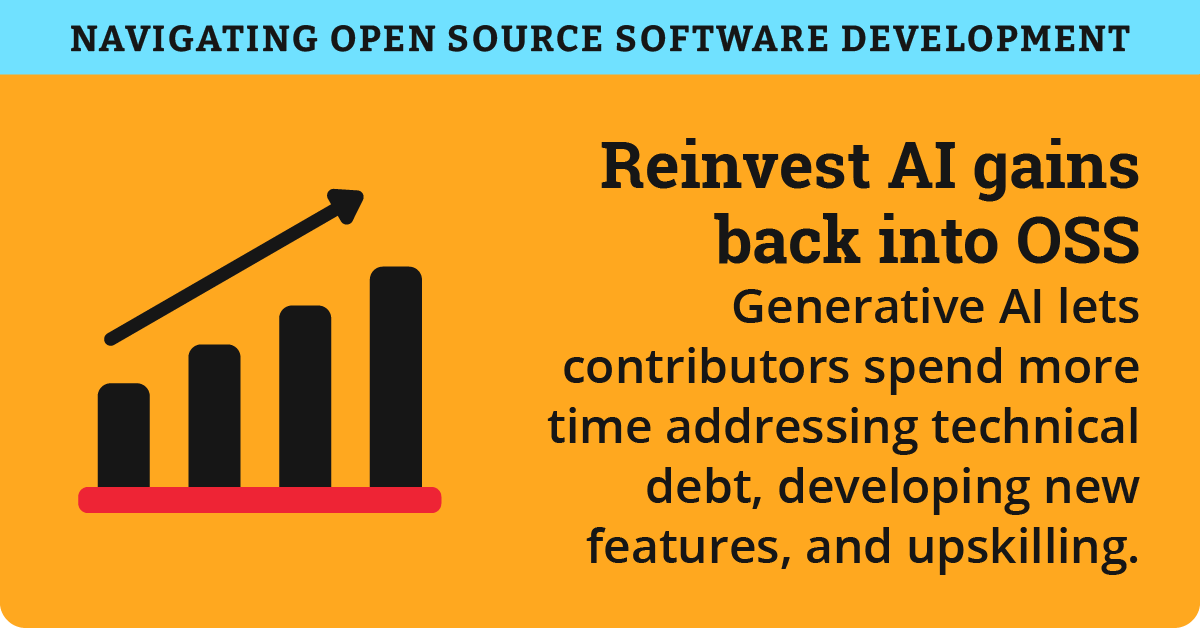
So, rather than reducing total hours spent in open source (a choice reported by only 16%), developers reallocate their time to a core set of higher-value, deferred priorities:
- 66% reinvest saved time into addressing technical debt.
- 63% direct their reclaimed hours into developing new features.
- 58% dedicate their time to learning and upskilling.
- 53% focus on quality assurance, test suites, and continuous integration.
This reallocation demonstrates that generative AI, when governed thoughtfully, allows developers to spend less time on repetitive code generation and more time on the architectural maintenance that ensures long-term sustainability.
Sustaining open source communities through proactive stewardship
Generative AI will neither undermine nor automatically fix open source software development. Its lasting impact will be shaped by the intentional policies, verification habits, and the mentorship structures established by project leaders today. And by combining disciplined engineering standards with a sustained commitment to human mentorship, open source communities can harness the speed of generative tools while preserving the trust, quality, and openness that make our ecosystem thrive.
To review the full data tables, methodology, and recommendations, read the complete research report: Navigating Open Source Software Development in the Generative AI Era: Challenges and Opportunities for Project Communities.
As always, we invite you to explore our entire collection of empirical studies, briefs, and community benchmarks by visiting the Linux Foundation Research Library. All of our report blogs and research updates can also be found at linuxfoundation.org/research, tagged under LF Research and related survey data.