
4 MIN READ
Hilary Carter | 25 February 2026
As a proud Canadian, I’ve always believed our country has a certain "polite" superpower: we are world-class at starting things. We pioneered the first national AI organization in the 1970s , we were the first in the world to launch a National AI Strategy in 2017 , and we currently produce 10% of the world’s leading AI researchers.
But as any Canadian who has waited for a delayed streetcar in a snowstorm knows, the "middle" and "end" of a journey can be a bit more complicated.
In our new report, The Value of Open Source AI for the Canadian Economy, co-authored with my fellow Canadian researcher Anna Hermansen, we took a deep dive into where Canada stands today. The results are a classic Canadian paradox: we are rank-leading in research and venture funding, yet we are "crawling" when it comes to implementing AI in our businesses.
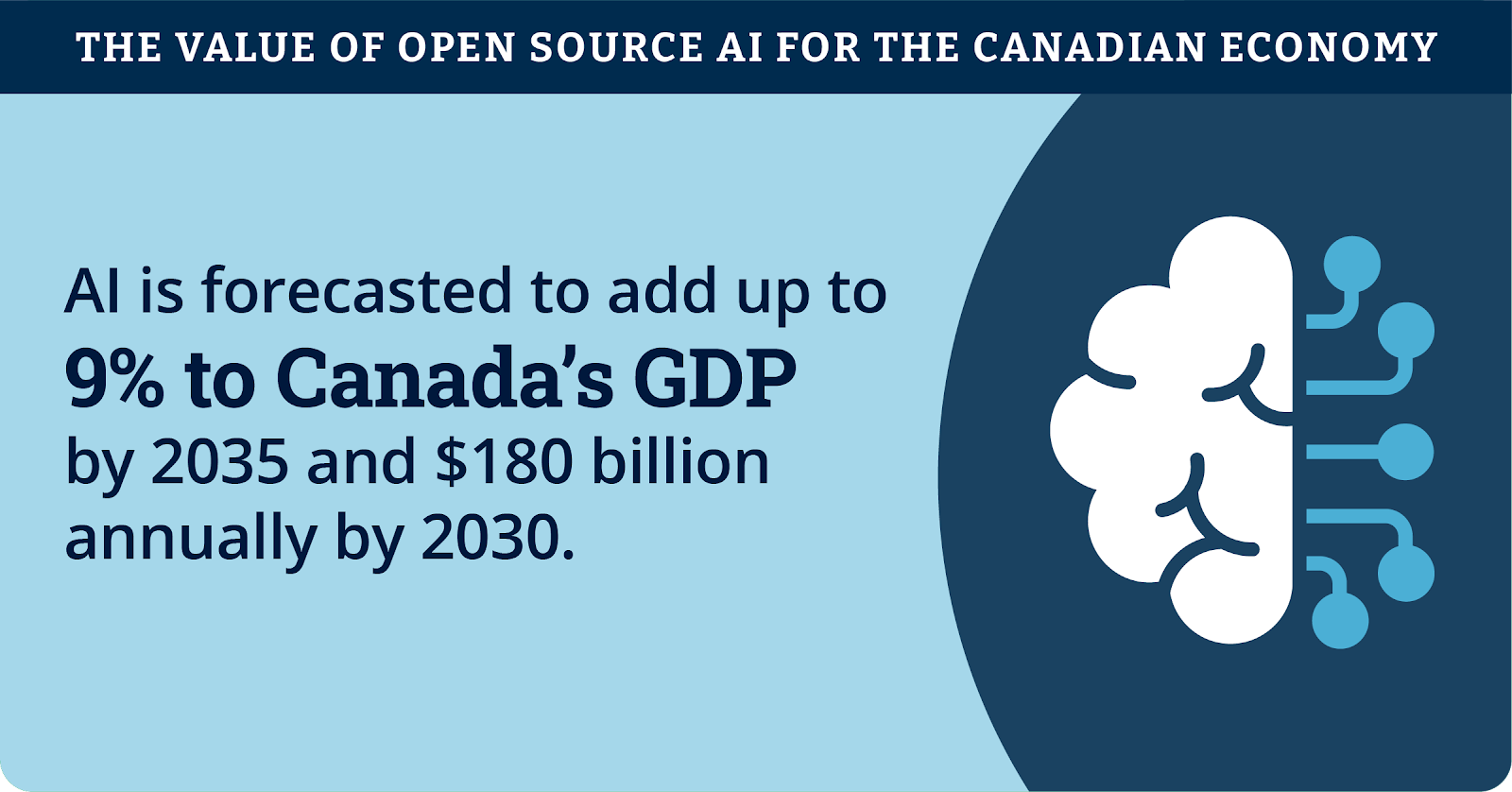
The stakes? Oh, just a casual $180 billion annual boost to our GDP by 2030 if we get this right.
Here is why Anna and I believe the secret to unlocking that potential—and finally moving from the "lab" to the "market"—is open source AI.
1. Productivity: Closing the Gap
It’s no secret that Canada’s productivity rate trails the United States by about 30%. AI is our best shot at closing that gap, with the potential to increase worker productivity by an average of 8%.
But here’s the kicker: only about one-quarter of Canadian firms have fully implemented AI solutions. For those who haven’t started on their AI journey, or need to fast-track it, open source AI acts as a "starter motor" for these businesses. It lowers the financial burden of adoption and prevents "vendor lock-in"—the tech equivalent of being stuck with a single cell phone provider in the 90s.
2. The Startup Accelerator: Move Like Silicon Valley
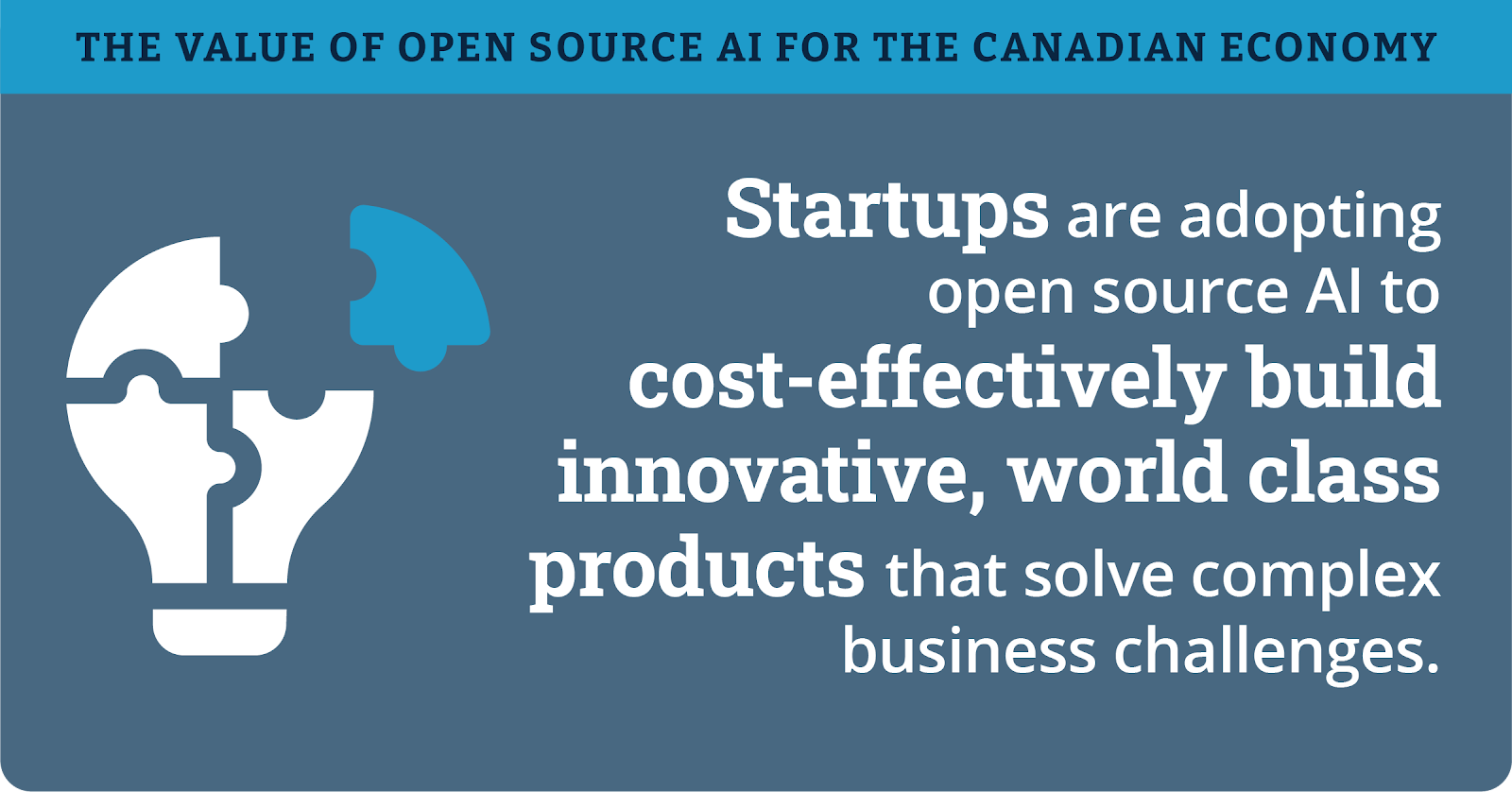
We have incredible tech hubs in Toronto, Montreal, Vancouver, and Calgary, and startups located all across the country. However, organizations of all sizes struggle to move publicly funded research into commercial products. This is a big opportunity for integrators and advisors to act as the glue to bind open source research excellence to commercialization.
In our research, we spoke with innovators like Ryan Hanley, CEO of Taskd.ai. He noted that using open models like Llama allows a small team to deliver enterprise-level results—faster quotes, fewer errors, and auditable data that stays with the customer. Open source provides the "pre-competitive innovation layer" that lets Canadian startups stop reinventing the wheel and start building the car.
3. Identity and Trust: AI That Actually Understands "Eh"
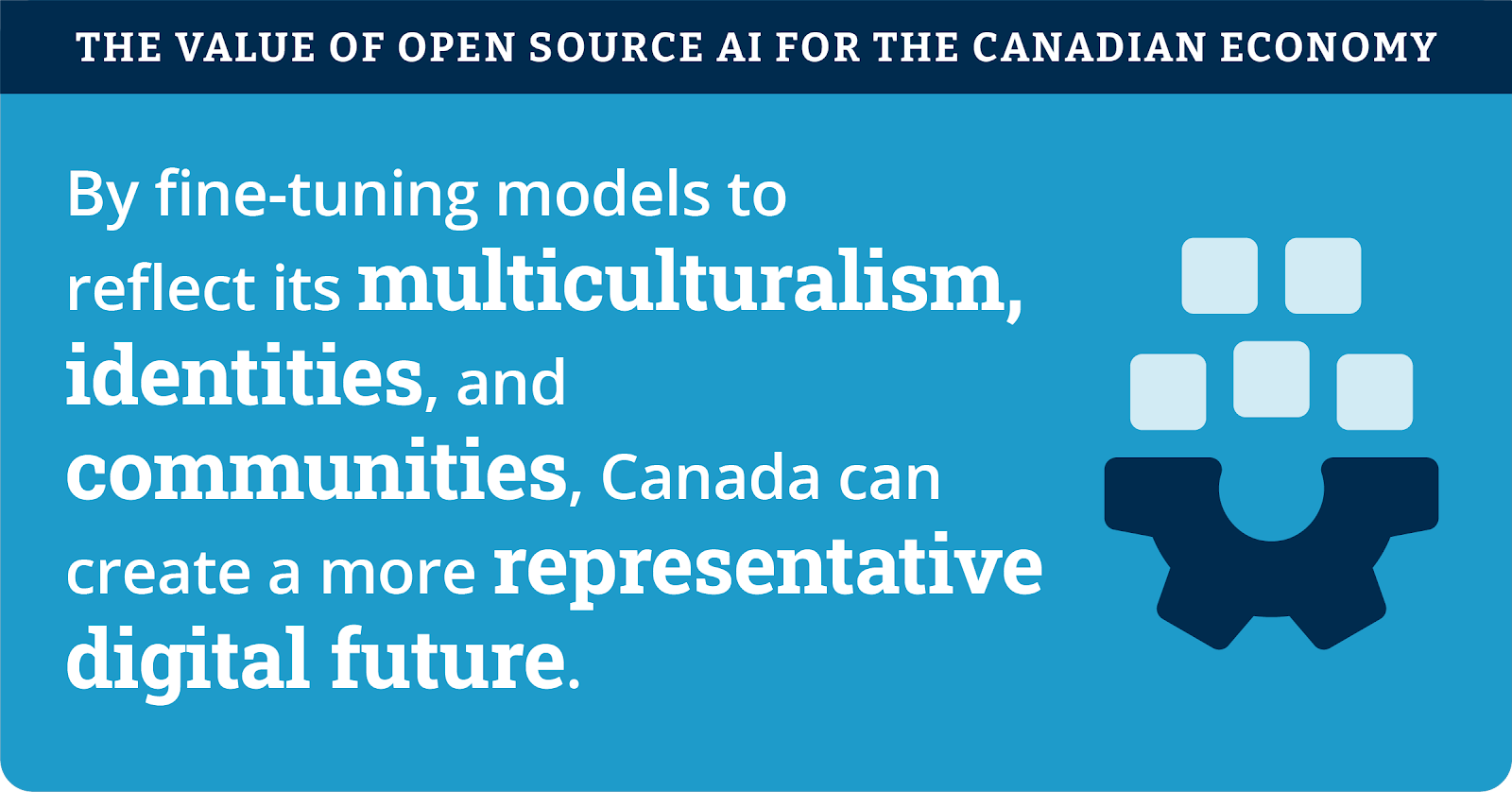
One of the most personal reasons to advocate for open source AI is its ability to reflect our unique multiculturalism and identities. Proprietary models are often "black boxes" trained elsewhere. Open source allows us to look under the hood and fine-tune models to reflect Canadian values. Training open models with data contextualized for Canadian businesses and consumers is where open models can add a whole new dimension.
We saw this in action with Mila’s FLAIR (First Language AI Reality) project, which uses AI for Indigenous language revitalization. Or Veracity, an open source app developed with Llama models to help Canadians fight misinformation. This isn’t just about code; it’s about digital sovereignty—ensuring our digital future looks like us.
4. Sector Spotlight: From Wheat Fields to Trading Floors
The impact isn't limited to tech. In agriculture, startups are using open source AI for pest identification and smart irrigation, helping our farms compete globally. In financial services, big banks like RBC, TD, and BMO are already using open source code to advance risk mitigation and customer experience.
Even our energy sector is getting a makeover. Hydro-Québec is a massive advocate for open source, using it to develop frameworks for power grid foundation models, to name just one example.
The Final Score
Canada stands at a pivotal moment. We have the researchers, we have the talent, and we have the energy resources to power the next generation of data centres. But to win the race, we have to "plant a flag" and commit to an ecosystem rooted in openness and collaboration.