
4 MIN READ
Nithya Ruff | 13 July 2026
This is a series from Linux Foundation Board Chair, Nithya Ruff. Part One can be found here.
In part one I highlighted stories of open source in academia that depend on some stability and continuity. A researcher must be in academia long enough to build something in the open, publish it, and shepherd it into a foundation before commercial pressure took over. Sage Weil spent years on Ceph as a graduate student. Justin Cappos has built five Linux Foundation projects across more than a decade at NYU. The Berkeley labs that produced Spark and Ray ran on five-year horizons. That precondition is eroding now in the realm of AI, perhaps the most important paradigm shift in technology history ever. Rather than stay and complete their research or build out more mature projects and directions, academics in AI are leaving for well-paying industry jobs. This has created a crisis for open source and the academic path that stretches beyond AI. Their work is captive to the company they work for and not broadly benefitting like it used to be.
The clearest evidence comes from a study in the Journal of Finance by Michael Gofman and Zhao Jin, who documented 211 departures of AI faculty from North American universities between 2004 and 2018. Of those, 149 professors took industry jobs and 62 left to found startups. The pace accelerated as deep learning took off, and the departures clustered at the top-ranked computer science departments that train the most influential students. In one widely cited episode, Uber hired roughly 40 researchers from Carnegie Mellon's robotics program in a single 2015 raid, hollowing out a lab that had taken decades to build.
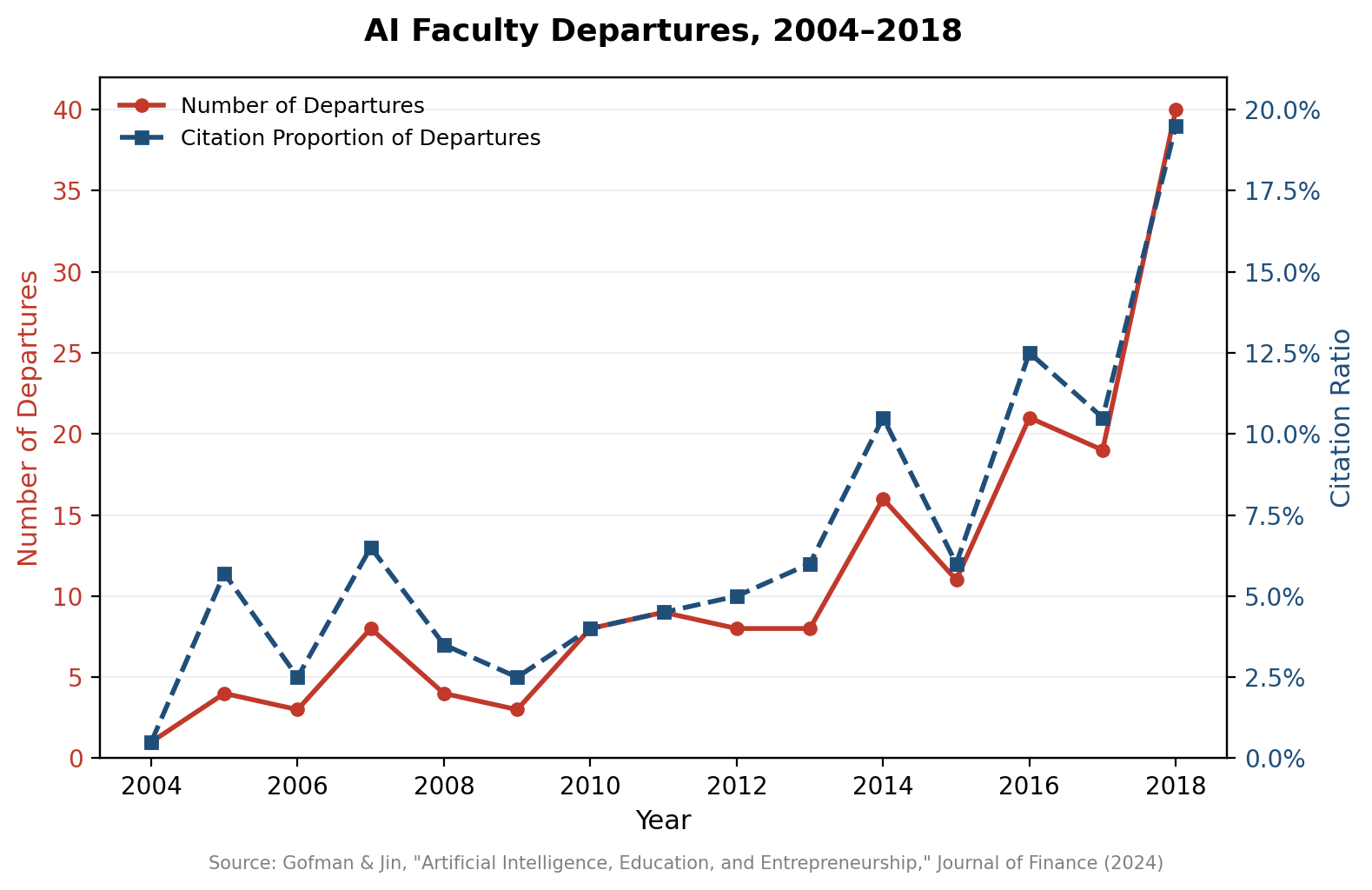
The mechanism is no mystery. A senior AI researcher can earn many times an academic salary at a frontier lab, and the gap has widened as model capabilities turned a small pool of experts into a strategic asset. Universities cannot match the compensation, and they increasingly cannot match the working conditions either, because the work itself has migrated to where the resources are.
Those resources are the second half of the problem. Training and evaluating modern models requires computing power that sits overwhelmingly inside a handful of companies. A 2024 survey of academic AI researchers found that most had access to only a few GPUs, with a large majority reporting they could not run the experiments they wanted because the hardware was out of reach. Researchers call this the compute divide, and its effect is to push mid-tier and lower-tier universities out of frontier AI research entirely while concentrating capability in elite institutions and large firms. The most recent International AI Safety Report identifies unequal access to compute as the single largest driver of the AI research and development divide.
Gofman and Jin found something more troubling than the departures themselves. When a tenured AI professor left, the universities they left behind produced measurably fewer AI entrepreneurs in the following years, and the effect was strongest for master's and PhD students and for departures of deep-learning faculty. The loss is not a one-time subtraction of a single researcher. It is the removal of the person who would have trained the next ten, which means the damage compounds across cohorts that never form.
This is why the talent drain is the core risk rather than one risk among many. The argument of Part 1 was that open source succeeded because academic researchers built foundational technology in the open and routed it through neutral governance before anyone monetized it. AI is inverting that sequence. Industry produced more than 90 percent of notable AI models in 2025, up from around 60 percent two years earlier, and most of that work is governed by restrictive licenses and unpublished training data rather than the open commons that made Spark and Ray possible. Innovation that once happened in public is moving behind closed doors, and the researchers best positioned to keep it open are the ones being hired away.
There is a more hopeful reading worth acknowledging, because the picture is not uniformly bleak. The 2026 AI Index found that the recent increase in new AI PhDs across the United States and Canada flowed into academic rather than industry positions, a sign that academia may be recovering some pull on early-career talent, and academia remains the leading source of the most highly cited AI research. The pull at the very top of the field, though, is what governs who trains the next generation and where public-interest expertise lives, and at that level the gravity still runs toward industry. A field that loses its senior researchers and its hardware at the same time does not stop producing AI. It stops producing AI that anyone outside a corporate boardroom can examine and reproduce, and it leaves the work of governing that AI to the institutions least able to do it impartially.
The migration of elite AI researchers from universities to industry, coupled with the centralization of computing resources, poses a significant risk to the future of open, democratic AI research and the training of the next generation of experts.
Despite these mounting challenges, universities possess unique, irreplaceable institutional strengths—such as neutrality and cross-disciplinary reach—that remain essential for establishing the safety, fairness, and accountability mechanisms that the industry cannot generate on its own. I’ll dive into the unique benefits universities bring to open source in Part Three.
.jpg?width=165&height=165&name=Nithya%20Ruff9253-Online%20(1).jpg)