5 MIN READ
Mirko Boehm | 24 June 2026

The Linux Foundation's 2026 State of Tech Talent Europe Report is out, and the headline findings will get most of the attention. LF Research, LF Education, and LF Europe have done careful, grounded work: 398 respondents, transparent methodology, a realistic perspective on what the data can and cannot show. Beneath the hiring statistics sits a serious question: what does it actually take to develop technical talent? Not just skills, but the ingenuity, curiosity, and entrepreneurial judgement that formal education alone does not produce, shaped as much by informal experience as by structured learning. Thierry Carrez's foreword frames the whole thing around digital sovereignty. What stuck out to me was the specifically European flavour of the junior tech talent gap.
Every new wave of automation triggers the same anxiety: that the machines will take the jobs and not give them back. Economists call the underlying misconception the lump of labour fallacy, and have been refuting it since David Ricardo worried about machinery and John Stuart Mill reassured his contemporaries about displacement. The 2026 data fits the optimistic pattern. European organisations report a net hiring effect of +27% for technical roles in 2026 and +17% in 2027. The World Economic Forum projects 78 million net new jobs globally by 2030. The displacement narrative is not what the survey shows, at least not yet and not in aggregate. The report is honest about its limits: self-reported perceptions from organisations already investing in AI, not economy-wide labour data.
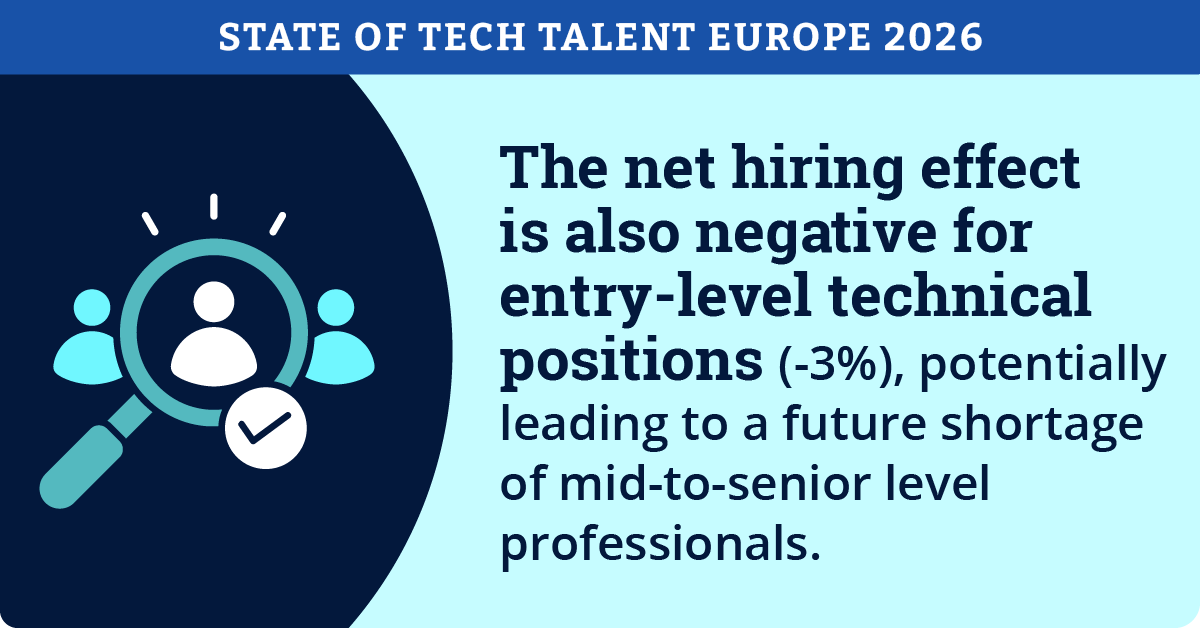
One finding cuts against that pattern. Europe's entry-level technical roles contracted by 3% in 2025. The rest of the world expanded junior hiring by 14%. That is a seventeen-percentage-point divergence, running in the opposite direction from the headline numbers. The report notes it: entry-level contraction earns its own line in the summary infographics. This detail surprised me. It is not a hiring blip. It is a structural break in how the technical profession reproduces itself.
I grew up in a culture that takes apprenticeship seriously. In German-speaking countries, learning a trade has always meant learning it from someone who already knows it: a master who invests time in a young person because they expect that person to eventually carry the craft forward. In trades, in workshops, in universities where professors are expected to balance Forschung und Lehre (research and teaching), the culture embeds an expectation that those who know will teach those who do not. The relationship is explicitly reciprocal. The apprentice contributes labour; the master contributes knowledge and mentorship. Both parties understand the trade-off.
That model has never translated well to software. Formal apprenticeships are rare in the tech industry; most engineers are largely self-taught, regardless of whether they hold a computer science degree. But the profession has always had an informal equivalent. The junior role served as the on-ramp: fixing small bugs, triaging tickets, writing boilerplate, maintaining test suites. Many open source projects highlight tasks for beginners. Not glamorous work, but work that required reading unfamiliar codebases, understanding organisational context, and sitting close enough to more experienced colleagues that tacit knowledge could pass between them. Remove those roles and the knowledge transfer stops.
AI is now automating exactly that kind of entry-level work. Code generation from specifications, test scaffolding, documentation, boilerplate of every kind: these are the first tasks to be absorbed. Organisations are not replacing senior engineers. They are replacing the work that junior engineers used to do. The master is training models instead.
There is a question that the optimistic data does not settle. Previous waves of automation displaced routine tasks but left ingenuity intact. AI may be different: for the first time, the tools that augment expertise can also simulate it, convincingly enough to change the economics of who gets hired.
What the data do show is that AI disproportionately benefits those who already have deep expertise. A principal engineer who can use AI to prototype, synthesise codebases, and review work at scale is more productive than ever. The human value in the loop is contextual judgement: knowing which trade-offs matter, what the technical debt means, how business constraints shape architecture. That judgement cannot be bypassed. It accumulates through years of situated experience.
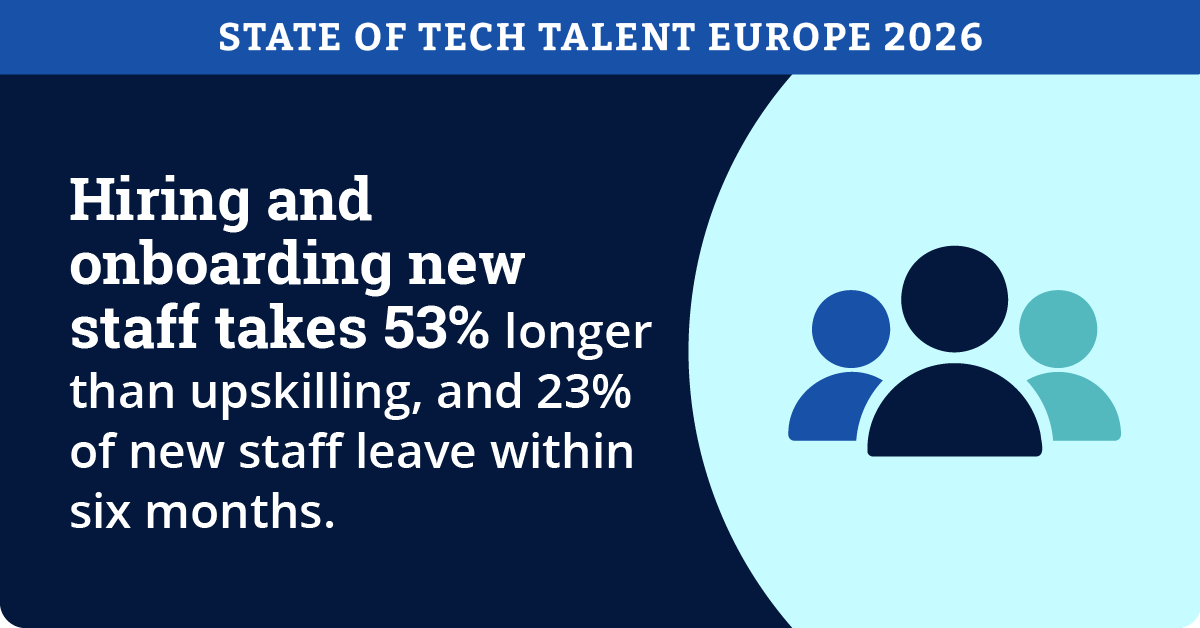
AI amplifies capability. It does not create it. A less experienced engineer using the same tools produces faster output, not better decisions. Remove the junior on-ramp and there is no reliable path to that expertise. The report's own numbers make the cost clear: hiring externally takes 53% longer to reach productivity, and 23% of new technical hires leave within six months. Growing experts from within is consistently faster and produces better retention.
Why is the European divergence so much sharper than elsewhere? The report does not say, but the structural conditions are suggestive. Europe's tech sector is dominated by small and medium-sized enterprises, few of which have the scale to run formal mentorship programmes or structured graduate schemes. The large enterprises that do exist are the segment most aggressively cutting junior headcount: organisations with more than 20,000 employees project a net hiring effect of -15% for 2027, the only size category in contraction. Small firms lack the capacity to develop junior talent in structured ways; large firms are reducing their intake. The junior tier falls between both.
Europe's strong preference for open source compounds this. Fifty-four percent of European organisations use open source as their primary strategy for implementing AI, against 36% globally. That is a genuine competitive advantage, but it raises the technical floor. Building on complex, production-grade infrastructure widens the gap between what a junior engineer can do on arrival and what the role requires. The mid-senior talent European organisations will need in 2036 is not being trained today. Fewer junior engineers are entering the profession. In a decade, there will be fewer senior ones.
There is an answer already latent in Europe's existing strengths. Open source communities have always functioned as informal apprenticeship systems. When I was a student learning to program, I found my way into the KDE community, where nearly every other contributor was more experienced than I was. Feedback was written, public, and unsparing. I learned more in that environment than from any structured course. The structure that made it work is not accidental: a maintainer can mentor dozens of contributors across time zones without co-location, contribution history is visible and verifiable portfolio evidence, and none of it requires an employer to provide the entry point.
Europe is better placed than it realises to use this. Europeans account for the largest share of contributions to CNCF and OpenInfra projects. Yet 73% of organisations acknowledge that open source culture is an effective development strategy while ranking it last in what they actually do. Organisations that deliberately route junior employees and career changers through OSS contribution pipelines are running a distributed apprenticeship at community scale, with feedback from practitioners with no stake in softening criticism.
The report's data on technical assessment support this. Hiring managers rate hands-on experience first (92%) and portfolio of project work second (84%). Certifications and university degrees are valued equally at 66%. An OSS contribution history is a portfolio; a Linux Foundation or CNCF certification is a credential in exactly the domains organisations say they need most. For a junior engineer navigating a contracting market, this can make a big difference.
The 2026 State of Tech Talent Europe report makes a strong case for upskilling existing staff, and the data support it. Upskilling closes current gaps in people already in the profession. However, focus should also be on feeding the junior pipeline. The entry-level contraction will not appear as a crisis for several years, which is precisely when it becomes too late to address quickly. Deeper engagement by young Europeans in global open source communities, alongside structured certification pathways, offers the most practical mitigation, and would strengthen exactly the capabilities that Europe's digital sovereignty agenda depends on. Read the full report.