
LINUX FOUNDATION RESEARCH
We’re investigating the impact of open source collaboration to solve the world’s most pressing challenges.
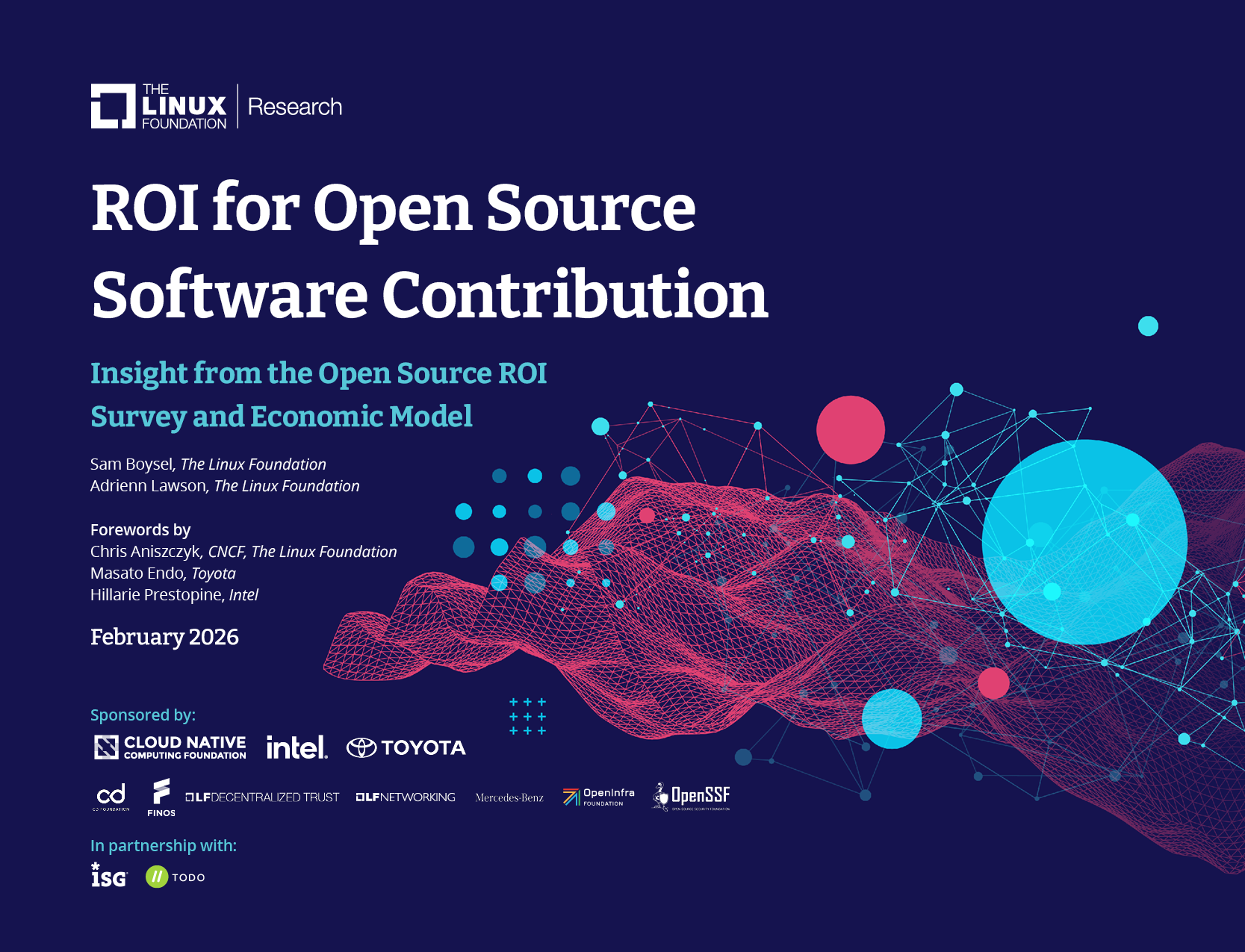
ROI for Open Source Software Contribution
What is the benefit of contributing to open source? In this study, LF Research has tackled this question through the analysis of results from a survey and quantitative model on contribution ROI.
Participate in Our Research
Join the LF Research Forum and participate in our surveys and interviews to give back to your community and earn events & training discounts!
Interested in conducting research?
Review our prospectus for more information, and email us at research@linuxfoundation.org
The Value of Open Source AI for APEC Economies
Download Report-
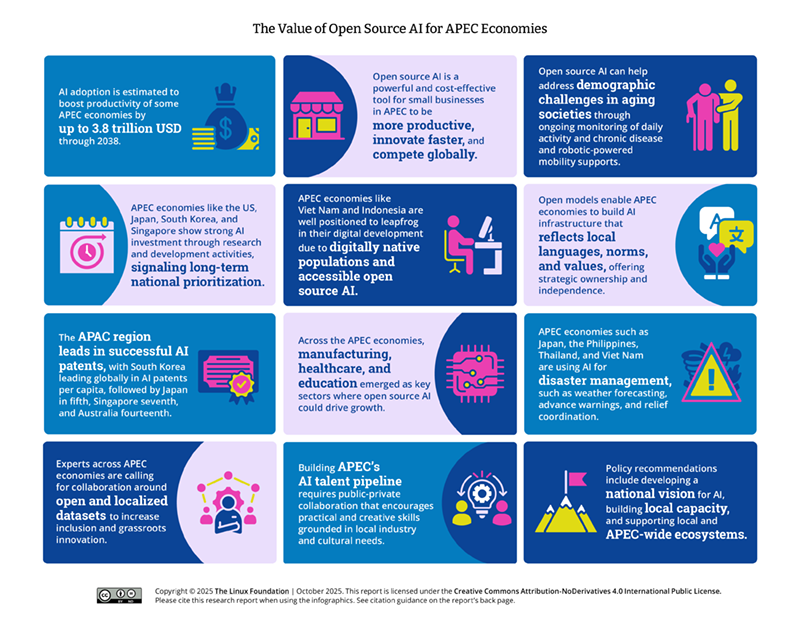
Significant adoption & investment rates: APEC economies show strong AI investment through R&D activities, signaling long-term national prioritization.
-
Economic benefits through productivity gains: AI is estimated to provide productivity boosts ranging from billions to trillions of USD to each economy through 2038.
-
Localization through open source: Open models enable APEC economies to build AI infrastructure that reflects local culture, circumstances, and competitive advantages, offering strategic independence.
- Sector-specific insights: manufacturing, healthcare, and education emerged as key areas for open source AI to drive growth; disaster relief needs make open source AI critical for economies such as Viet Nam and Thailand; and agriculture-rich economies such as Indonesia are relying on OSAI applications to improve operations and supply chain.
-
Anna Hermansen, the Linux Foundation
-
Kirsten D. Sandberg
Our Team
Filter by:

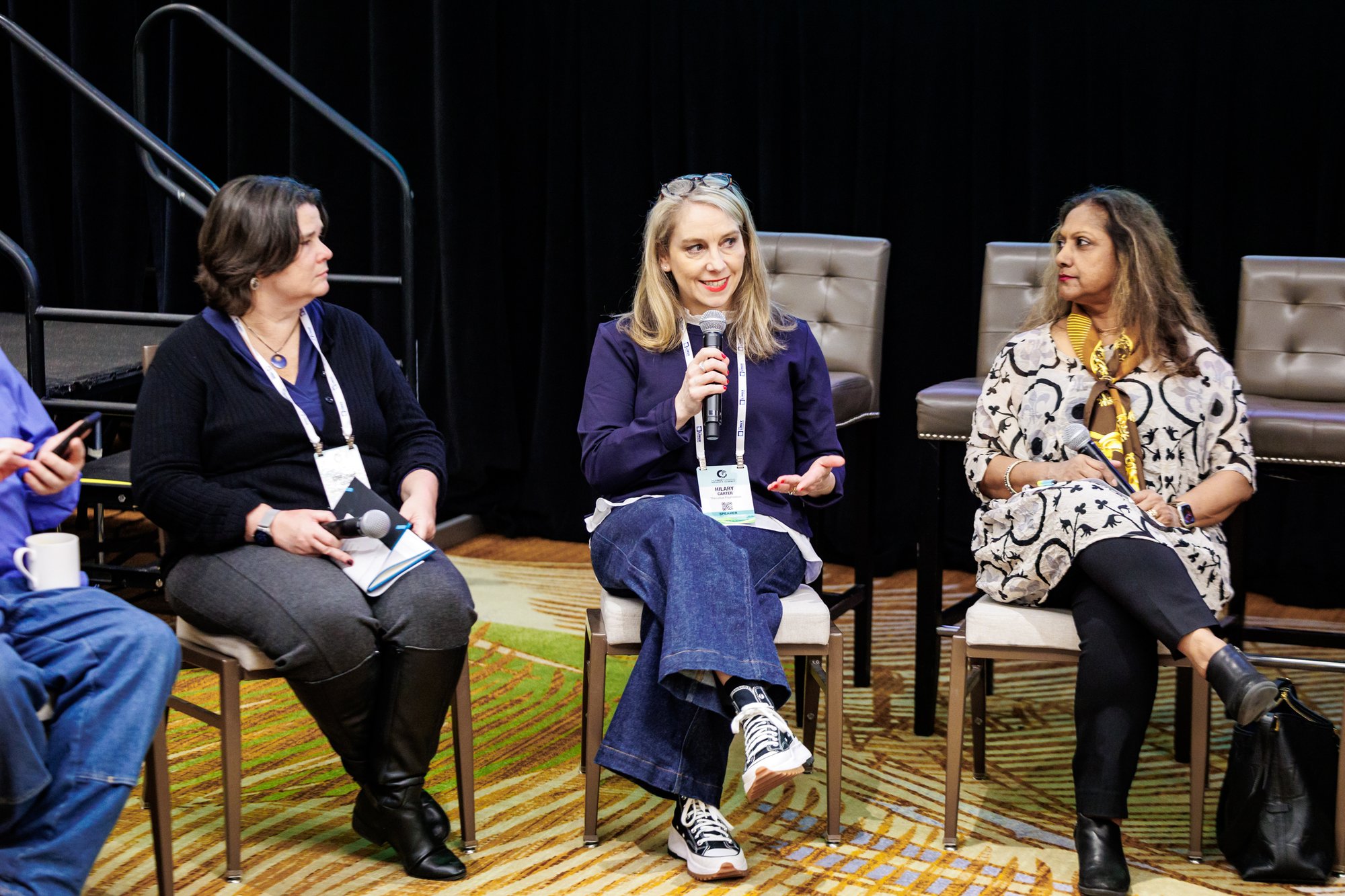
Hilary Carter
SVP, Research
Hilary Carter joined the Linux Foundation in 2021 to launch and lead LF Research, established to deliver empirical insights into open source trends, opportunities, and challenges. Prior to joining the Linux Foundation, Hilary led a global, syndicated research institute focused on blockchain technology based in Toronto, Canada. She has authored and led nearly 200 research projects focused on open source innovation and its adoption across industries. Hilary holds a Master of Science in Management from the London School of Economics, and holds dual Irish and Canadian citizenship.
Adrienn Lawson
Director of Quantitative Research
Adrienn serves as Director of Quantitative Research at the Linux Foundation, where she leads data-driven initiatives to understand open source ecosystems. With expertise in social data science from the University of Oxford and a background spanning academic and governmental research, she brings methodological rigor to analyzing distributed collaboration networks.
At the Linux Foundation, Adrienn leads a team conducting cross-sectional research across industry verticals and geographic regions to provide comprehensive insights into open source dynamics. Her work encompasses empirical investigations into regulatory compliance, the implications of AI, and sustainable funding models. She produces evidence-based recommendations that inform strategic decision-making within the open source community.
Anna Hermansen
Senior Researcher & Ecosystem Manager
Anna is the Ecosystem Manager for LF Research where she supports end-to-end management of the Linux Foundation's research projects. She has conducted qualitative and systematic review research in health data infrastructure and the integration of new technologies to better support data sharing in healthcare. She is a generalist with experience in client services, program delivery, project management, and writing for academic, corporate, and web user audiences. Prior to the Linux Foundation, she worked for two different research programs, the Blockchain Research Institute and BC Cancer's Research Institute.

Marco Gerosa
Data Analyst
Dr. Marco Aurélio Gerosa is a Full Professor of Computer Science at Northern Arizona University (NAU), USA. His recent research includes exploring AI and chatbots to support open source communities. He earned his Ph.D. in Computer Science from the Pontifical Catholic University of Rio de Janeiro (PUC-Rio) and has published over 300 peer-reviewed papers. He has expertise in quantitative and qualitative research methods and mining software techniques.

Sam Boysel
Data Scientist
Sam Boysel is a Data Scientist at the Linux Foundation. He has extensive empirical research experience across many topics in the open source ecosystem. His work leverages microeconomic theory to explore incentives, behaviors, and place value on open source dynamics. Before joining the Linux Foundation, Sam was a postdoctoral researcher with the Laboratory for Innovation Science at Harvard. He holds a B.A., M.S., and Ph.D. in Economics.

Bianca Trinkenreich
Data Analyst
Dr. Bianca Trinkenreich is an Assistant Professor of Computer Science at Colorado State University (CSU), USA. Her recent research includes exploring human-centric AI, software teams' culture, developer experience and technostress. She earned her Ph.D. in Computer Science from Northern Arizona University and has published over 50 peer-reviewed papers. She has expertise in mixed-methods studies involving both quantitative and qualitative research methods and mining software techniques.
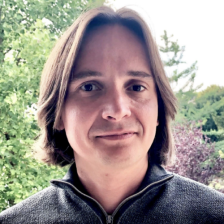
Lucian Balea
RTE
Lucian is Open Source Program Director at RTE, the French power transmission system operator. He is leading the open source strategy of RTE which aims at moving the digitalization of the power grid into a new era. Early 2018, he started a collaboration with The Linux Foundation to launch LF Energy, an open source coalition to speed technological innovation and support the energy transition across the world. Today, Lucian is deeply involved in LF Energy and serves as Chair of the Governing Board.
Lucian has been with RTE since 2003 where he held several management positions in the fields of R&D, markets and finance.

Henry Chesbrough
UC Berkeley
Henry Chesbrough is best known as “the father of Open Innovation”. He teaches at the Haas School of Business at the University of California-Berkeley, where he is the Faculty Director of the Garwood Center for Corporate Innovation. He is also Maire Tecnimont Professor of Open Innovation and Sustainability at Luiss University in Rome. Previously he was an Assistant Professor at Harvard Business School. He holds a PhD from UC Berkeley, and MBA from Stanford, and a BA from Yale University. He has written books such as Open Innovation (Harvard Business School Press, 2003), Open Business Models (Harvard Business School Press, 2006), Open Services Innovation (Jossey-Bass, 2011) and Open Innovation Results (Oxford, 2020). His research has been cited more than 90,000 times, according to Google Scholar. He has been recognized as one of the leading business thinkers by Thinkers50. He received an Innovation Luminary award from the European Commission in 2014. He received the Industrial Research Institute Medal of Achievement in 2017, and has two honorary doctorates.

Dirk Hohndel
Ericsson
Dirk is the Head of Ericsson Software Technology, leading a team of engineers working on upstream open source contributions. He brings nearly four decades of software and open source leadership, most recently as head of Verizon's Open Source Office, focused on open source governance and security. Before that, he spent six years as VMware's Chief Open Source Officer, establishing the company’s OSPO and driving its involvement in the open source community, and nearly fifteen years at Intel as Chief Linux and Open Source Technologist, shaping the company's open source strategy. He began his executive career as the first CTO of SUSE Linux.
Dirk has been a software developer and part of many free software and open source communities since the late 1980s, helping build and grow projects like Linux, KDE, Yocto, and most recently Subsurface and adsb.im. He has served on the boards and advisory boards of a number of open source foundations, including the Linux Foundation, KDE, GNOME, and the Free Standards Group. He holds a degree in Mathematics and Computer Science from the University of Würzburg and lives in Portland, Oregon.
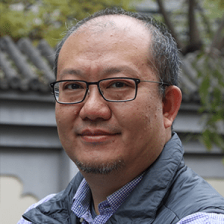
Peixin Hou
Huawei
Peixin Hou is currently serving as the Chief Architect of Open Software and Systems in the Central Software Institute, Huawei. He has been working in the software industry for over 20 years and has experience in operating systems, mobile software, media processing, and cloud computing.
Peixin started his open source journey in 2000 and is now an active strategist and evangelist in the field. He is involved in defining various key strategies on open source for Huawei and leads the company’s FOSS development in areas such as Linux and containers. He also serves as a board or steering committee member in several open source projects, such as Cloud Native Computing Foundation and Core Infrastructure Initiative. Peixin has also represented Huawei on the board of Linaro.
Peixin received his Ph.D. from the University of Surrey, UK in electronic and electrical engineering.

Anni Lai
Futurewei
Anni Lai is a longtime open source community builder, advocate, and evangelist. With nearly a decade of active involvement in the global open source ecosystem, she has supported developer communities across more than 40 countries and five continents. She currently serves as Co-Chair of the Generative AI Commons and an elected board member of LF AI & Data, and she also advises LF Europe, GOSIM, and KAIYUANSHE and leads the Open Source Operations at Futurewei. Anni is a passionate believer that AI should serve the global population—rooted in ethics, trust, and openness. Anni holds a B.A. and an M.S. in Computer Science from Rutgers University and San José State University, respectively.
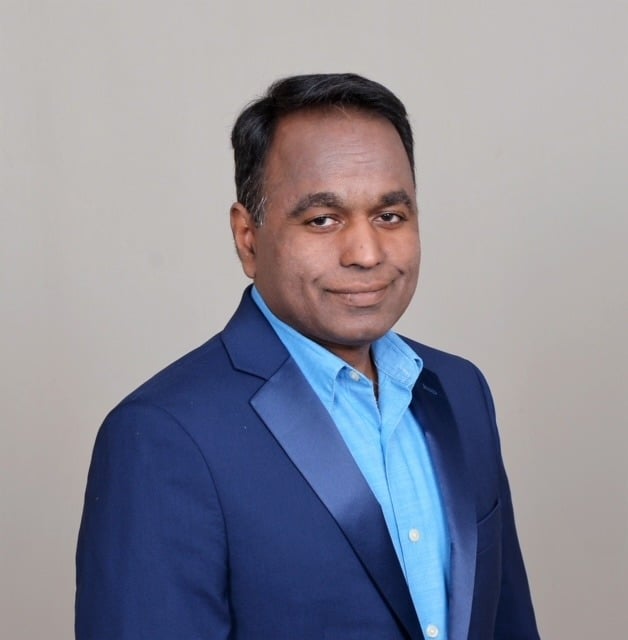
Rao Lakkakula
Microsoft
Rao Lakkakula leads the open-source ecosystem team at Microsoft. In the past, he led security and engineering teams at JPMorgan Chase, Amazon, and Climate Technologies. Rao is passionate about open-source security and is a key member of the initial team that started Open-Source Security Foundation (OpenSSF).
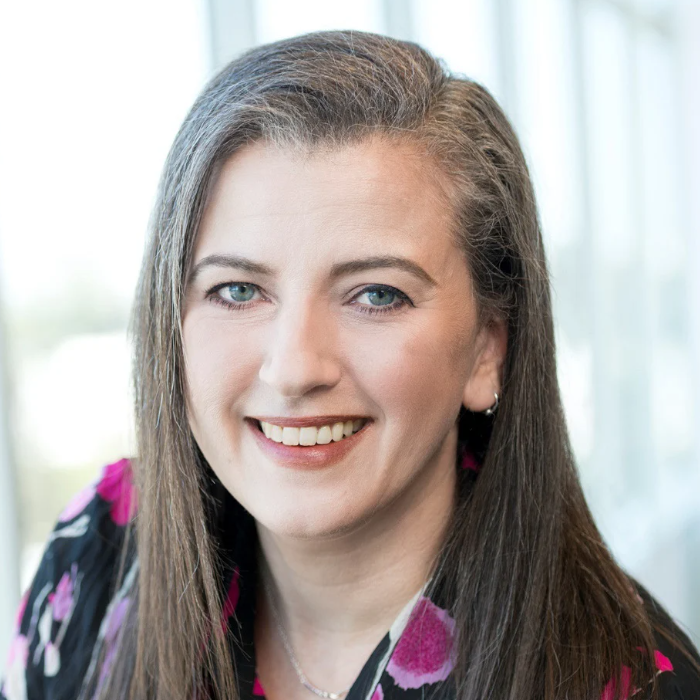
Jessica Marz
Intel
Jessica Marz leads Intel’s Open Source Program Office. As experts in explaining legal concepts to software developers and software development concepts to lawyers, she and her team are responsible for defining and managing Intel’s open source software consumption and production policies. Personally and professionally, she eats, breathes, and sleeps all things “open” and DIY. She has spoken at open source events such as the FSFE Legal & Licensing Workshop, FOSDEM, Copyleft Conference, FOSS North, and various Linux Foundation conferences. Jessica holds a JD from Santa Clara University School of Law, an MBA from San Jose State University, and a BA in English from UCLA.

Jessica Murillo
IBM
Jessica Murillo is Vice President, Open Systems Development at IBM. She leads a broad set of software development teams, including the IBM Linux Technology Center, collaborative software development, virtualization, containers, cloud computing, and next generation workload solutions across IBM’s POWER and IBM Z servers. The Open Systems Development organization is a worldwide team that is distributed across Australia, Brazil, China, France, Germany, India, and the United States.
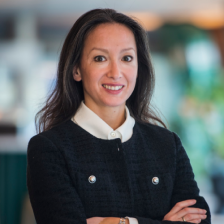
Sachiko Muto
OFE/RISE
Sachiko Muto is the Chair of OpenForum Europe and a senior researcher at RISE Research Institutes of Sweden. She originally joined OFE in 2007 and served for several years as Director with responsibility for government relations and then as CEO. She has degrees in Political Science from the University of Toronto and the London School of Economics and has been a guest researcher at UC Berkeley and TU Delft.

Frank Nagle
MIT
Frank Nagle is Microsoft's Chief AI Economist, based in the AI Economy Institute within Microsoft's AI for Good Lab. He is also a research scientist at the Initiative on the Digital Economy at MIT. His research focuses on the economic impacts of emerging technologies, including how artificial intelligence is transforming firms, innovation, productivity, and labor markets.His research falls into the broader categories of the future of work, the economics of IT, and digital transformation. His work frequently explores the domains of open source software, crowdsourcing, free digital goods, cybersecurity, and generating strategic predictions from unstructured big data. Frank’s work has been published in numerous academic journals including Management Science, Organization Science, Strategic Management Journal, Research Policy, Strategic Management Review, and Academy of Management Annals as well as in the practitioner-oriented publications Harvard Business Review, MIT Sloan Management Review, and Brookings Institution TechStream. He has won awards and grants from AOM, NBER, SMS, INFORMS, EURAM, the Sloan Foundation, and the Linux Foundation.
Frank serves on the advisory board at Nexleaf Analytics and Alphamatician and advises other big data analytics startups. He has advised the OECD Working Party on Innovation and Technology Policy and was on the European Commission/ Open Forum Europe Board of Experts for the Impact of Open Source on Technological Independence, Competitiveness, and Innovation in Europe. He has consulted for The World Bank, the U.S. Treasury Department, the Social Security Administration, and various companies in the technology, defense, and energy sectors. He is currently a Term Member of the Council on Foreign Relations.
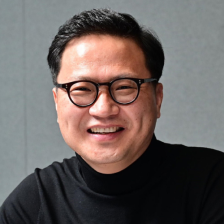
Daniel Park
Samsung
Dr. Daniel Park is a head of open source group in Samsung where he is responsible for open source strategy, corporate governance and compliance operation, project development and developer relationship and all kinds of open source stuffs. He has many experiences in terms of global standard and collaboration including W3C advisory board and working group chair, IETF working group chair, OCF vice president and open source work group chair, and currently his experience is being expanded to open source communities. He received his Ph.D from Kyung Hee University in Computer Engineering.
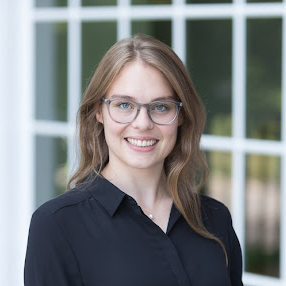
Maria Roche
Harvard Business School
Maria Roche is an Assistant Professor of Business Administration in the Strategy Unit at Harvard Business School. She teaches Strategy in the MBA required curriculum. Her research focuses on the sourcing, production and diffusion of knowledge, which she examines in various contexts including cities, co-working spaces, universities, and open source platforms. Her work, published at The Review of Economics and Statistics, Organization Science and Research Policy, has been featured, a.o., in The Atlantic, Handelsblatt and the WSJ.
Professor Roche earned her PhD in Management (Strategy and Innovation) at the Scheller College of Business, Georgia Institute of Technology, where she was a recipient of a NSF Science of Science and Innovation Policy Doctoral Dissertation Research Improvement Grant. She earned an MS in Business Administration and a BA in International Cultural and Business Studies at the University of Passau, Germany.
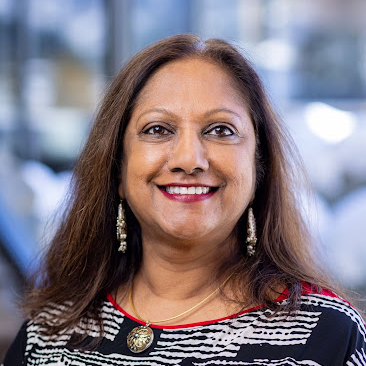
Nithya Ruff
LF Board Chair
Nithya A. Ruff is the Head of the Amazon Open Source Program Office. She drives open source culture and coordination inside of Amazon and engagement with external communities. Open Source has proven to be one of the world’s most prolific enabler of innovation and collaboration, and Amazon’s customers increasingly value open source innovation and the cloud’s role in helping them adopt and run important open source services. Prior to Amazon, she started and grew Comcast and Western Digital’s Open Source Program Offices. Open Source Program Offices are a critical part of a company’s digital transformation and innovation journey and enable the intentional and systematic engagement with open source for companies.
Nithya has been director-at-large on the Linux Foundation Board for the last 5 years and in 2019 was elected to be Chair of the influential Linux Foundation Board. She works actively to advance the mission of the Linux Foundation around building sustainable ecosystems that are built on open collaboration.

Keiichi Seki
NEC
Keiichi Seki is a leading member of the open source program office in NEC Corporation, and is responsible for NEC’s open source strategy. He leads NEC’s developer teams who are actively contributing to open source communities, such as Kubernetes and OpenStack. He also helps encourage people in the NEC group of companies to join and contribute to open source communities. He handles intellectual property issues regarding open source software patents, and has been a technical committee member of the Open Invention Network since 2019.
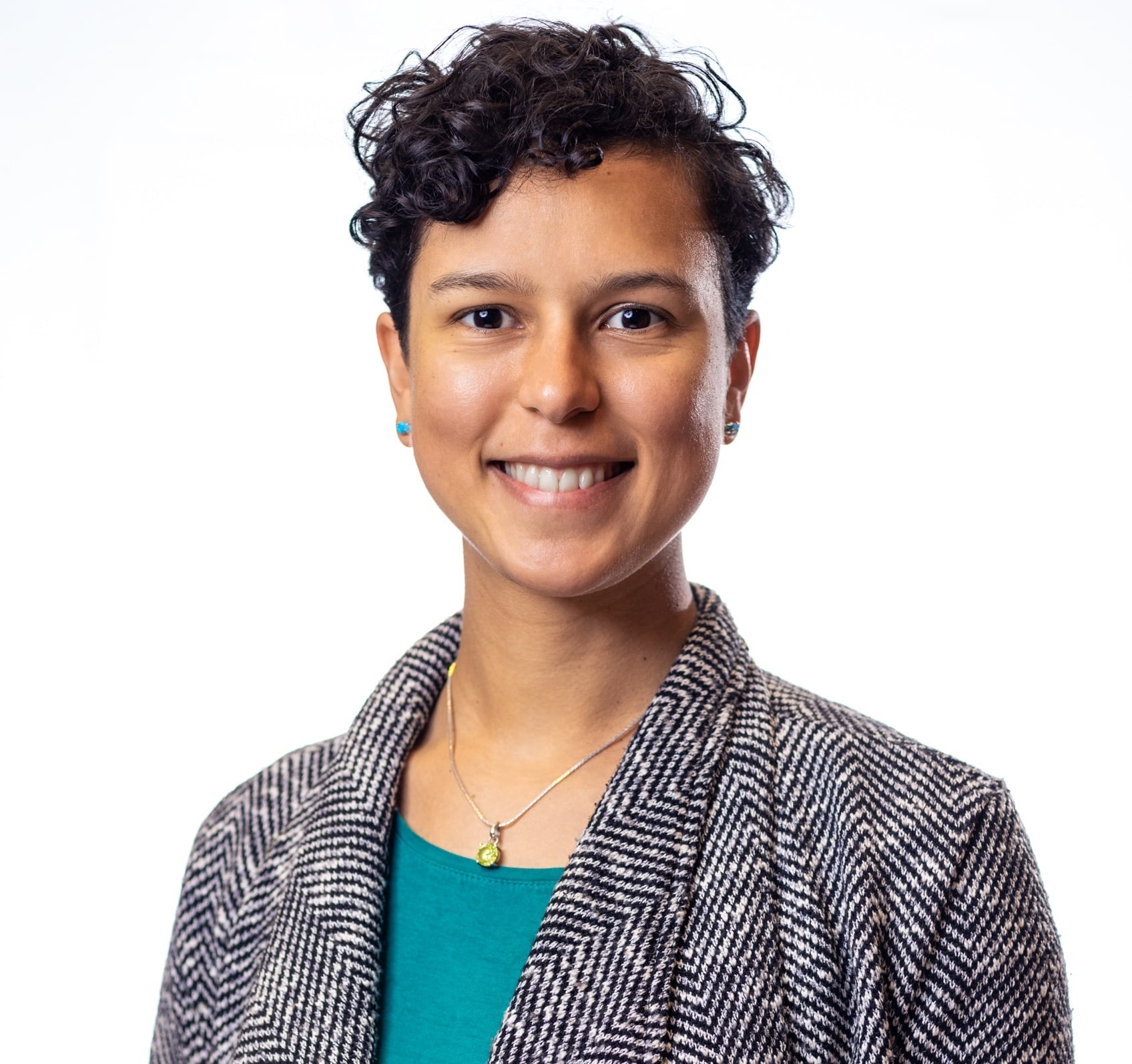
Sophia Vargas
Sophia Vargas is an Analyst, Researcher, and Program Manager in Google’s Open Source Programs Office. In this role she leads efforts that investigate project health, contributor experience, operational models, and the sustainability of open source ecosystems. She is also on the Governing Board and an active contributor to the CHAOSS community. Prior to Google, Sophia was an analyst at Forrester Research, covering data center infrastructure and cloud strategy.

Irving Wladawsky-Berger
MIT
Dr. Irving Wladawsky-Berger is Visiting Lecturer at MIT’s Sloan School of Management, a Fellow of MIT’s Initiative on the Digital Economy and of MIT Connection Science.
He retired from IBM in May of 2007 after a 37 year career with the company, where his primary focus was on innovation and technical strategy. He’s been an Adviser on Digital Strategy at Citigroup, at HBO, and at MasterCard. He’s been writing a weekly blog,irvingwb.com, since 2005, and was a guest columnist at the Wall Street Journal CIOJournal.
Dr. Wladawsky-Berger received an M.S. and a Ph. D. in physics from the University of Chicago.

Mike Dolan
Senior Vice President and GM of Projects
Michael Dolan is SVP and GM of Projects supporting open source projects, research, and legal programs at The Linux Foundation. He has set up and launched hundreds of open source and open standards projects covering technology segments including networking, cloud, blockchain, Internet of Things, AI/ML, security, storage, and embedded devices. Mike also runs open source legal programs for the Linux Foundation’s members’ legal counsel community which has led to collaborations on standards such as OpenChain and SPDX.
Prior to joining The Linux Foundation, he spent eight years at IBM in roles across systems, services, and software. He received an M.B.A. from Case Western Reserve University, a J.D. from Cleveland State University, and a B.S. in economics from John Carroll University. Mike is a member of the Ohio State Bar Association.

Jim Zemlin
Executive Director
Jim Zemlin’s career spans three of the largest technology trends to rise over the last decade: mobile computing, cloud computing, and open source software. Today, as executive director of The Linux Foundation, he uses this experience to accelerate innovation in technology through the use of open source and Linux.
At The Linux Foundation, Jim works with the world’s largest technology companies, including IBM, Intel, Google, Samsung, Qualcomm, and others to help define the future of computing on the server, in the cloud, and on a variety of mobile computing devices. His work at the vendor-neutral Linux Foundation gives him a unique and aggregate perspective on the global technology industry.
Jim has been recognized for his insights on the changing economics of the technology industry, and he is a regular keynote speaker at industry events. He advises a variety of startups, including Splashtop, and sits on the boards of the Global Economic Symposium, Open Source For America, and Chinese Open Source Promotion Union.